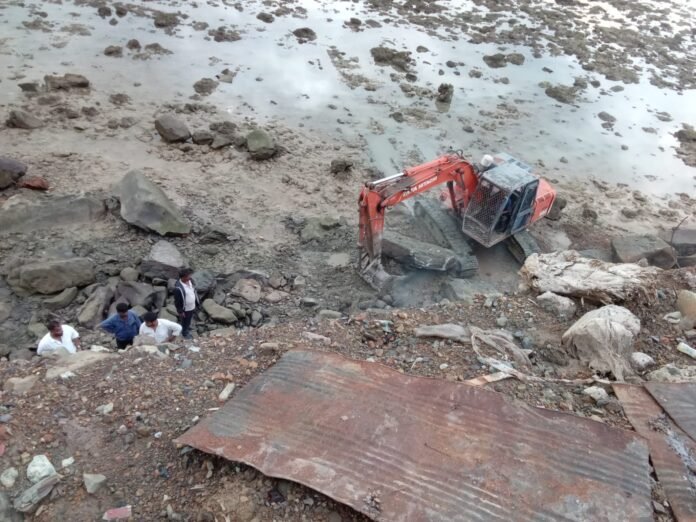
Sri Vijaya Puram, June 4: The collapse of a retaining wall at Mazar Pahad has renewed scrutiny of the delayed implementation of Smart City projects in Sri Vijaya Puram, with several key infrastructure works still unfinished despite the programme crossing its final completion deadline more than a year ago.
The damaged retaining wall, located along one of the city’s most visited coastal stretches, currently has no approved reconstruction plan. While restoration of the collapsed structure remains undecided, authorities are focusing on debris clearance and temporary safety measures at the site.
The incident has emerged as a visible reminder of the challenges facing infrastructure execution in the Andaman and Nicobar Islands, where multiple Smart City projects continue to remain incomplete despite repeated extensions granted under the national urban renewal mission.
According to officials, the retaining wall was originally constructed by a private contractor. Following the collapse, the Public Works Department (PWD) assumed responsibility for immediate restoration and safety-related works.
PWD teams are presently engaged in removing soil that slipped from the affected slope and clearing stones and debris from the damaged section. Authorities have also installed a temporary barricade-like structure along part of the site to prevent public access and ensure safety.
However, officials confirmed that no formal proposal, planning exercise or official meeting has yet been conducted regarding reconstruction of the retaining wall. The current focus remains limited to site stabilization, debris removal and preventive measures.
The uncertainty surrounding the wall’s future has highlighted broader concerns over the status of Smart City projects across Sri Vijaya Puram.
The Smart City Mission, launched to modernize urban infrastructure and public amenities, was initially scheduled for completion in June 2020. However, the programme subsequently received multiple extensions, first to June 2023, then June 2024, and finally to March 31, 2025.
Despite the revised timelines, several projects remain incomplete in 2026.
Data available with the Sri Vijaya Puram Municipal Council indicates that out of 18 identified Smart City projects, 10 have been completed while six remain under implementation. Several ongoing works are particularly visible along the Marina Park-to-Corbyn’s Cove corridor, one of the city’s flagship tourism and public infrastructure zones.
Municipal officials attribute the delays to a combination of logistical challenges, supply chain disruptions and tendering difficulties.
“Logistical constraints, supply disruptions and repeated tendering challenges have become major issues, directly delaying project execution and limiting bidder participation,” a municipal official told The Wave Andaman.
The execution challenges have also affected projects beyond the Smart City Mission. A recent tender floated to address recurring monsoon flooding in Aberdeen Bazaar reportedly failed to attract any bidders, leaving one of the city’s most persistent civic problems unresolved.
Officials familiar with the matter said the absence of contractor participation reflects the increasing difficulties associated with executing public infrastructure projects in the Islands.
Unlike mainland cities, the Andaman and Nicobar Islands depend heavily on maritime transportation for the movement of construction materials, heavy machinery and specialized equipment. Weather conditions, shipping schedules and freight availability often determine the pace of project execution.
Officials noted that disruptions in shipping schedules frequently delay the arrival of critical construction materials, leading to interruptions in project timelines and contractor mobilization.
Material shortages have further complicated infrastructure development. One of the major setbacks came after stone-crushing operations at Brookshabad and Prothrapur were halted following intervention by the National Green Tribunal over concerns related to dust pollution and the potential impact on perennial water sources.
The suspension affected the availability of locally sourced aggregates, an essential component for road, drainage and structural works, during a crucial phase of project implementation.
Similarly, restrictions on quarry and moorum allotments in Little Andaman constrained access to construction materials for several years. Contractors were increasingly forced to rely on imported materials from mainland India, adding to transportation costs and project timelines.
Urban planners and officials say these challenges collectively illustrate the unique constraints faced by island territories, where infrastructure development is heavily dependent on external supply chains and environmental regulations.
With no reconstruction roadmap yet prepared for the Mazar Pahad retaining wall and multiple Smart City projects continuing beyond their revised deadlines, the episode has once again highlighted the persistent logistical, procurement and implementation hurdles confronting large-scale infrastructure development in Sri Vijaya Puram.
As residents and visitors continue to witness unfinished works across key stretches of the city, questions remain over when the remaining projects will finally be completed and whether the long-delayed urban transformation envisioned under the Smart City Mission can be fully realized.