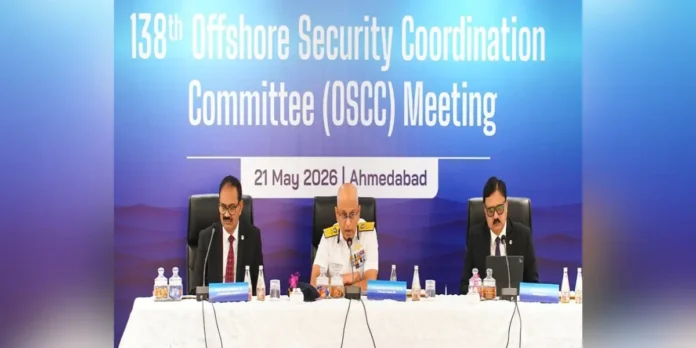
Ahmedabad, May 23: India’s offshore security framework came under review amid growing strategic focus on the Andaman and Nicobar region and emerging maritime threats, with discussions centred on strengthening surveillance, coordination and response mechanisms.
The review took place during the 138th Offshore Security Coordination Committee (OSCC) meeting, chaired by Director General of the Indian Coast Guard Paramesh Sivamani in Ahmedabad. The meeting assessed current preparedness to safeguard offshore installations and critical energy infrastructure across maritime zones.
Key areas of focus included enhancing maritime domain awareness, improving inter-agency coordination, and augmenting surveillance capabilities to respond effectively to evolving threats. Officials also examined the need for stronger joint response mechanisms in light of changing security dynamics.

Deliberations addressed the shifting global and regional security environment, with particular emphasis on modern warfare trends such as unmanned systems and drone-enabled threats. The discussions also highlighted the increasing offshore exploration activities in the Andaman and Nicobar region, underscoring its growing strategic and economic importance.
Representatives from multiple agencies attended the meeting, including the Indian Coast Guard, Indian Navy, Indian Air Force, Ministry of Home Affairs, Ministry of External Affairs, Ministry of Petroleum and Natural Gas, Directorate General of Shipping, Intelligence Bureau, Oil and Natural Gas Commission, and state police forces. The participation reflected a multi-agency approach to securing offshore assets.
The committee reiterated the need for coordinated action among stakeholders to ensure the protection of critical maritime infrastructure and offshore installations. The review emphasised that safeguarding these assets is essential for maintaining energy security and supporting national economic growth.
The Offshore Security Coordination Committee, constituted in 1978, continues to play a key role in shaping policies and addressing operational challenges related to offshore defence areas. Its mandate includes guiding security frameworks and facilitating cooperation among agencies involved in maritime security.

In earlier remarks, the Coast Guard leadership had stressed the importance of securing offshore assets as a critical component of national development and energy independence, reinforcing the need for continuous monitoring and preparedness.
Separately, Coast Guard Headquarters marked the retirement of senior officers scheduled to superannuate on May 31, acknowledging their service in safeguarding maritime frontiers. A session on financial planning and health management was also organised to support their transition.
The security review comes at a time when maritime zones, particularly around the Andaman and Nicobar Islands, are witnessing increased activity, making coordinated surveillance and response systems central to national security planning.