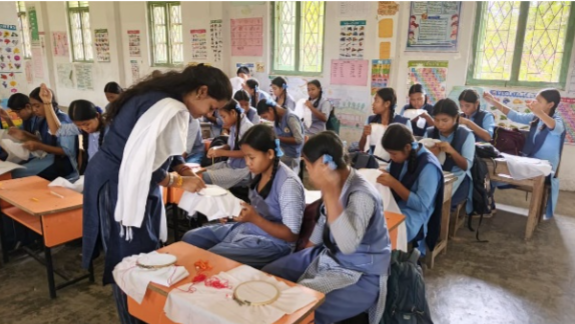
Car Nicobar, May 5: In a major push towards vocational education and youth empowerment, the Education Department of Car Nicobar has launched skill-based training programmes for school students during the Summer Vacation 2026, with the initiative commencing today at Government Senior Secondary School (GSSS) Sawai.
The programme aims to equip students with practical skills that enhance employability, self-reliance, and livelihood awareness at an early stage. A total of 175 students have enrolled in the first phase at GSSS Sawai, where structured, hands-on training sessions are currently underway.
Officials stated that the initiative will be implemented in a phased manner across three Cluster Resource Centres (CRCs) in Car Nicobar. Following the Sawai session from May 4 to May 9, the programme will continue at GSSS Malacca from May 11 to May 16, involving around 240 students. The final phase will be conducted at GSSS Lapathy from May 18 to May 23, with participation from 69 students.
The training modules have been designed to provide exposure to a range of vocational trades, including plumbing, electrician work, carpentry, local craft making, mat making, coir-related activities, and tailoring. These courses focus on hands-on learning, enabling students to gain practical experience rather than just theoretical knowledge.
According to officials from the Education Department, the initiative aligns with broader efforts to integrate skill development into the education system and prepare students for diverse career pathways beyond conventional academic routes. The programme also reflects a growing emphasis on vocational training in island regions, where skill-based livelihoods play a significant role in the local economy.
The Industries Department, along with ITI Car Nicobar, is playing a key role in the implementation of the programme by providing technical expertise and trained resource persons. Their involvement ensures that students receive quality instruction and are introduced to industry-relevant practices.
Community participation has also been a crucial component of the programme’s success. Village Headmen have actively mobilized students from their respective areas, encouraging participation and ensuring strong local engagement. Parents, too, have responded positively, recognizing the value of vocational skills in enhancing future opportunities for their children.
Education officials expressed appreciation for the collective efforts of all stakeholders, including village authorities, parents, and students, in making the initiative a success. They noted that such programmes not only help in skill development but also instill confidence and independence among young learners.

The department emphasized that early exposure to vocational training can play a transformative role in shaping career choices and reducing dependency on limited job avenues. By introducing students to multiple trades, the programme allows them to explore their interests and develop practical competencies that can be useful in both employment and entrepreneurship.
With the successful rollout of the first phase at Sawai, authorities are optimistic about strong participation in the upcoming sessions at Malacca and Lapathy. The initiative is expected to serve as a model for similar programmes in other parts of the Andaman and Nicobar Islands.
As the islands continue to focus on holistic education and sustainable livelihood opportunities, such skill-based training programmes are likely to become a key pillar in preparing the next generation for real-world challenges.