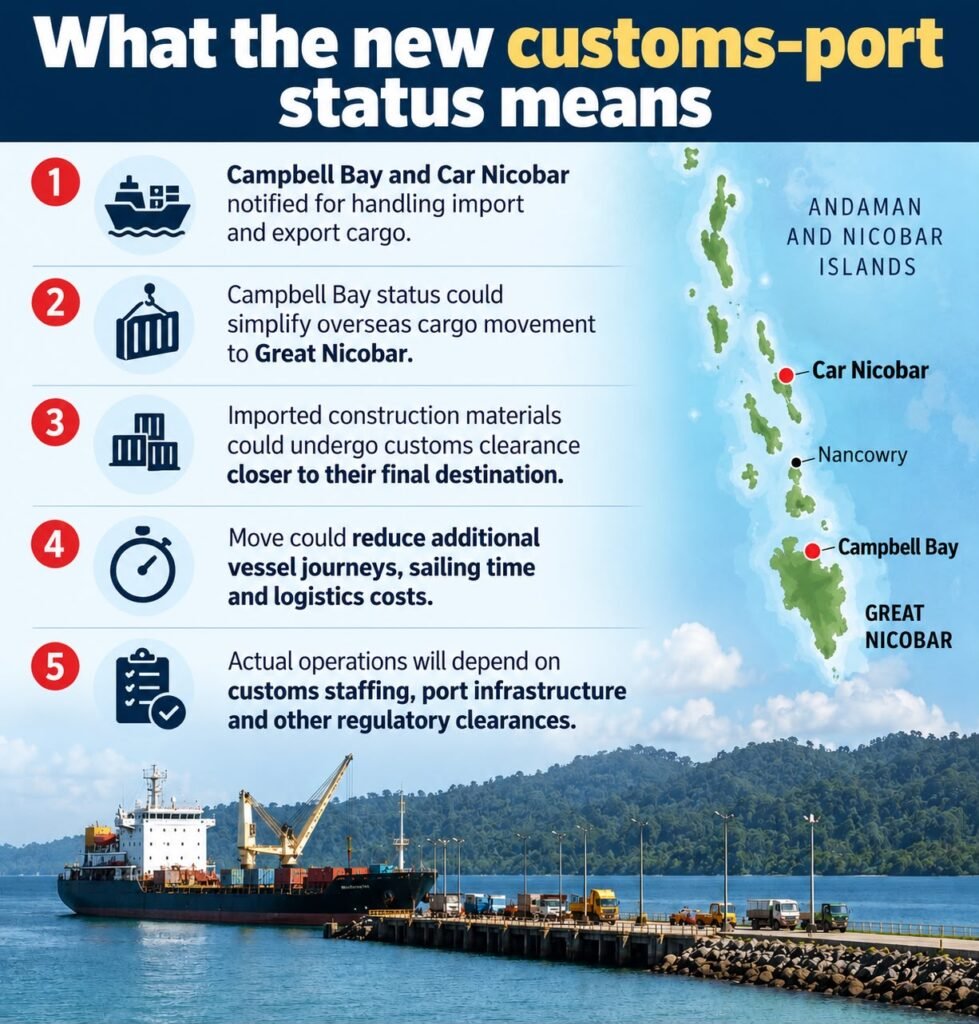
Sri Vijaya Puram, Sept. 26: Campbell Bay and Car Nicobar have been notified as customs ports for handling import and export cargo, potentially removing a key logistical hurdle for overseas shipments headed to the Nicobar Islands, particularly Great Nicobar.
The Central Board of Indirect Taxes and Customs (CBIC), under the Ministry of Finance, notified the two locations on September 23 through Notification No. 76/2026-Customs (N.T.). The notification allows imported goods to be unloaded and export goods to be loaded at both locations.
The move assumes particular significance for Campbell Bay at a time when construction activity in Great Nicobar is expected to require substantial movement of building materials, machinery and equipment.
At present, imported construction materials destined for Great Nicobar have involved an additional customs-clearance leg. Vessels carrying materials such as boulders, stone dust and river sand imported from nearby countries, including Malaysia, have had to proceed to Nancowry for customs clearance before continuing towards Great Nicobar.
With Campbell Bay now brought within the customs framework, such cargo could potentially undergo customs formalities much closer to its final destination, subject to the required operational arrangements and regulatory approvals.

What changes
Shipping and logistics experts said the most immediate benefit could be the elimination of an additional voyage for vessels that currently have to call at another notified location for customs purposes.
For large barges carrying thousands of tonnes of construction material, the change could potentially reduce sailing time, fuel consumption and overall logistics costs, they said. The extent of the savings would, however, depend on the origin of the cargo, vessel route and customs procedures involved.
The notification is an enabling measure and does not mean Campbell Bay and Car Nicobar will immediately start functioning as full-fledged international cargo hubs.
Importers will continue to require normal customs documentation and clearances and will have to pay applicable duties. Depending on the vessel and nature of the cargo, permissions from port, security, immigration, quarantine and other authorities may also be necessary.
Experts said the effectiveness of the move would therefore depend on how quickly supporting arrangements are put in place, including customs personnel, inspection facilities and adequate infrastructure for berthing, handling and storing cargo.
The notification also does not relax India’s existing import restrictions or provide any customs-duty concession. It essentially allows the two locations to serve as legal gateways for specified import and export operations.
Great Nicobar link
Campbell Bay’s inclusion is particularly important because of the scale of infrastructure development proposed for Great Nicobar.
The Great Nicobar Island Project includes an International Container Transshipment Terminal at Galathea Bay, a greenfield international airport, power infrastructure and a township, along with associated development.
Infrastructure and logistics experts said projects of this scale would require sustained movement of construction materials, heavy equipment and machinery. Given Great Nicobar’s distance from mainland India, the ability to handle imported cargo closer to the project sites could simplify the supply chain.
Its geographical proximity to Southeast Asia could also make overseas sourcing relevant for some materials. Any such imports, however, would continue to be governed by India’s trade, environmental, quarantine and other applicable regulations.

The notification has a potentially wider implication as well. Campbell Bay and Car Nicobar have been authorised not only to receive imports but also to load goods for export.
This creates the regulatory framework for goods to eventually be customs-cleared for export from the two islands themselves, although experts said the commercial viability of such operations would depend on cargo volumes, shipping connectivity and supporting port infrastructure.
For Car Nicobar, the notification similarly creates the possibility of handling international cargo without necessarily routing it through another customs location.
The move should not, however, be confused with the establishment of new international commercial ports. Customs notification is only one part of the process. Actual cargo operations will depend on shipping services, port infrastructure, customs staffing, security arrangements and commercial demand.
Still, for Great Nicobar, the change addresses a practical issue that has complicated the movement of imported construction materials.
If the required customs and port arrangements are operationalised at Campbell Bay, vessels carrying permitted overseas cargo could potentially complete customs formalities closer to their destination instead of undertaking an additional voyage for clearance — shortening what has so far been a longer and more cumbersome supply chain.