Sri Vijaya Puram, Sept. 21: Apprehension is growing among merchants across the Andaman and Nicobar Islands over the proposed Merchant Discount Rate (MDR) on certain UPI transactions, with small traders worried that accepting digital payments could become more expensive.
With QR payments now commonplace across shops, restaurants, hotels, taxis and tourism businesses in the Islands, the proposed changes have triggered questions over who will actually have to pay and which businesses will be affected.
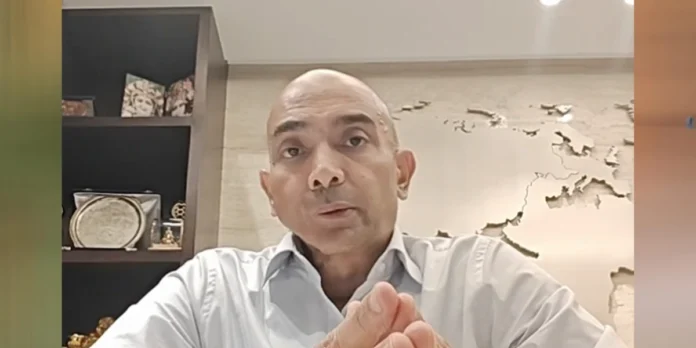
BJP’s Girish Arora has now stepped in to allay those fears, claiming that consumers will continue to pay nothing for UPI transactions while smaller merchants will remain protected under specified thresholds.
Arora, a Member of the National Traders Welfare Board under the Ministry of Commerce and Industry, former President of the Andaman Chamber of Commerce and Industry and President of the Hotel Association of Andaman and Nicobar, claimed that much of the apprehension had been triggered by reports suggesting that all UPI payments above ₹2,000 would attract charges.

He maintained that the MDR should not be confused with a transaction fee imposed on consumers.
“UPI will remain entirely free for the public and will continue to remain free,” Arora said, adding that person-to-person (P2P) transactions would also remain free.
According to Arora, individuals sending money to family members, friends or other individuals through UPI will not have to pay a transaction charge, irrespective of the amount transferred.
Small Andaman traders seek clarity
Arora claimed that the changes primarily concern the merchant side of the UPI ecosystem. According to him, eligible person-to-merchant (P2M) transactions above ₹2,000 will attract an MDR of 0.4 percent, while payments of ₹2,000 and below will remain free.
He further claimed that for transactions of ₹75,000 and above, the MDR will be capped at ₹300 per transaction.
According to Arora’s explanation, an eligible merchant transaction of ₹3,000 would attract an MDR of ₹12, while a ₹50,000 transaction would attract ₹200. On a ₹1 lakh transaction, the normal 0.4 percent calculation would amount to ₹400, but the MDR would be capped at ₹300.
Arora, however, claimed that this does not mean every small trader receiving a UPI payment above ₹2,000 will automatically face a deduction.
He said small merchants covered under the Person-to-Person-Merchant (P2PM) framework and receiving up to ₹1 lakh per month through UPI QR codes will continue to enjoy zero-MDR protection.
The issue assumes particular significance in the Islands, where digital payments have become deeply embedded in everyday commerce. Apart from neighbourhood grocery and retail stores, QR payments are widely accepted by restaurants, homestays, hotels, tour operators, taxi drivers and other service providers catering to residents and tourists.
For many small businesses in the Islands operating on relatively modest volumes, the crucial question will therefore be how they are classified under the proposed framework rather than merely the size of an individual transaction.
Arora claimed that the applicability of MDR will depend on the merchant category and prescribed thresholds, and not simply on whether an individual payment crosses ₹2,000.
He also urged traders and consumers not to rely on unverified social media messages and forwards and instead refer to official government information and FAQs.
Arora further claimed that certain sectors will receive separate treatment. According to him, payments above ₹2,000 in specified categories including railways, telecommunications, insurance, fuel and agricultural inputs will attract a flat MDR of ₹5 per transaction instead of the standard 0.4 percent rate.
He also claimed that capital-market transactions involving mutual funds, securities, stockbrokers and dealers will attract an MDR of 0.02 percent, subject to a maximum cap of ₹300 per transaction.
Consumers will continue to pay nothing
For residents as well as tourists visiting the Islands, Arora claimed that the key point is that the customer-facing side of UPI will remain free.
According to him, person-to-person transfers will continue without MDR, while customers scanning a UPI QR code at a shop, restaurant, hotel or other establishment will not have to pay the merchant’s MDR.
Arora also claimed that merchants covered by the framework will not be permitted to pass the MDR charge on to UPI customers, meaning consumers would continue to pay the displayed price without an additional UPI fee.

The issue is particularly relevant to Andaman and Nicobar’s tourism economy, where transactions between visitors and local businesses form a significant part of everyday commercial activity. QR payments are now routinely used by tourists to pay hotels, restaurants, taxi operators, shops and tourism service providers across the Islands.
Arora said the proposed MDR mechanism was intended to support the financial sustainability of the UPI ecosystem and continued investment in payment infrastructure, cybersecurity, innovation and customer service. He claimed that the charge would be distributed among participants in the payment ecosystem, including banks and payment service providers, rather than being collected as a government tax.
Citing government data, Arora said UPI processed 2,451 crore transactions worth ₹29.9 lakh crore in August 2026 alone.
Arora maintained that the immediate need in the Islands was for merchants to understand which category they fall under rather than assume that every UPI transaction above ₹2,000 will cost them money.
For consumers, his message was that UPI itself was not becoming a paid service and that customers would continue to make payments without an additional charge.
Arora claimed that the new MDR framework is scheduled to come into effect from October 15, 2026.