Sri Vijaya Puram, Oct. 01: Geopolitical disruptions are exposing vulnerabilities in global shipping and energy routes, making alternative maritime corridors, stronger connectivity and deeper India-ASEAN cooperation an immediate priority, experts said at a conference in New Delhi. The discussions also highlighted the strategic importance of strengthening India’s engagement with ASEAN, including through the Andaman and Nicobar Islands.
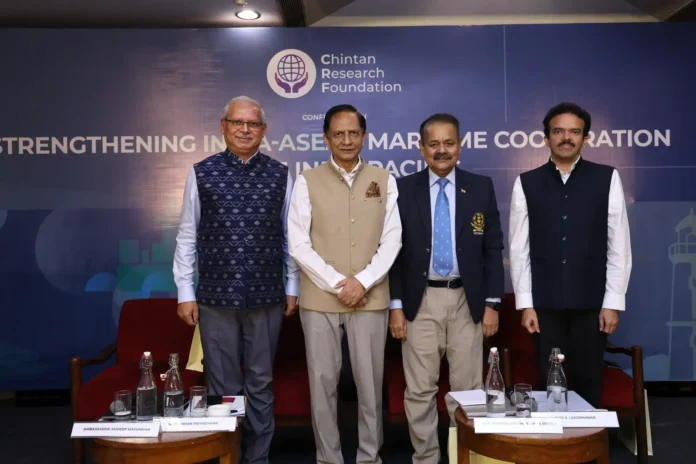
The conference on “Strengthening India-ASEAN Maritime Cooperation in the Indo-Pacific”, organised by the Chintan Research Foundation (CRF), brought together analysts who called for greater cooperation to keep maritime routes secure and supply chains resilient amid continuing geo-economic uncertainty.
Former Joint Secretary at the Ministry of Ports, Shipping and Waterways R Lakshmanan said the cost of hiring a Very Large Crude Carrier (VLCC) had risen nearly tenfold from the pre-crisis period, while container ship hiring costs had increased fivefold. He said such increases affect manufacturing, logistics costs and the resilience of supply chains.
Lakshmanan pointed to stronger information-sharing as one way to reduce the impact of maritime disruptions. He suggested expanding the role of the Information Fusion Centre–Indian Ocean Region (IFC-IOR), hosted by the Indian Navy and currently focused on maritime security, naval and coast guard-related information, to include commercial shipping by involving port authorities and customs agencies.

Such an expansion, he said, could help track disruptions affecting trade and commercial shipping and improve the sharing of relevant information.
Ambassador Jaideep Mazumdar said India-ASEAN maritime cooperation had developed into a structured, multidimensional partnership, but stressed the need to convert existing convergence into practical outcomes and joint responses to expected and unforeseen maritime contingencies.
Vice Admiral Shekhar Sinha (Retd.) stressed that open and secure oceans and safe shipping lanes remain essential for shared growth and prosperity in an interdependent global economy.
The conference also examined ways to align the ASEAN Outlook on the Indo-Pacific, India’s Indo-Pacific Oceans Initiative, Act East Policy and MAHASAGAR more effectively. Participants discussed maritime security, supply-chain resilience, energy cooperation, alternative connectivity corridors and stronger East Coast port capacity.

The Strait of Hormuz crisis was cited as an illustration of how disruptions at distant energy routes and chokepoints can affect wider regional interests. Speakers called for diversified energy and trade routes, stronger maritime domain awareness and information-sharing, alongside greater naval and coast guard cooperation, coordinated patrols, exercises, humanitarian assistance and disaster relief, search-and-rescue operations and protection of critical sea lanes.
The discussions specifically underlined the need for India to deepen engagement with ASEAN through capacity-building, defence cooperation and connectivity, including in the Andaman and Nicobar Islands.
Speakers also called for greater use of ASEAN-led platforms such as the ASEAN Regional Forum and ASEAN Defence Ministers’ Meeting-Plus. With the India-ASEAN dialogue partnership approaching 35 years in 2027, the conference identified sustained implementation, institutional coordination and crisis preparedness as central to translating established cooperation into continuous operational outcomes.