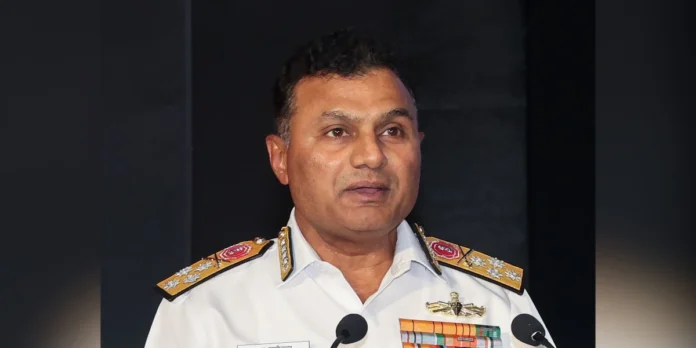
Sri Vijaya Puram, November 17: A military base on Great Nicobar Island would strengthen India’s naval reach near the Malacca Strait, through which nearly 30 percent of the world’s seaborne oil passes, Navy chief Admiral Krishna Swaminathan has said. His assessment comes as the Iran-US war highlights the vulnerability of global energy supplies to disruptions at critical maritime chokepoints.
In an interview with ANI, Admiral Swaminathan said a military presence closer to the strait would improve the Navy’s ability to monitor shipping movements and carry out operations along sea lanes connecting the Indian Ocean with Southeast Asia and the Pacific.
“There is absolutely no doubt” about the military advantage of such a location, he said, although the decision to establish a base rests with the government.
According to the US Energy Information Administration (EIA), approximately 23.2 million barrels of crude oil and petroleum products passed through Malacca daily in the first half of 2025, compared with 20.9 million barrels through the Strait of Hormuz. Malacca is also a major transit route for liquefied natural gas shipments to East Asia.
The two waterways have different implications for India’s energy security. Hormuz is critical to India’s oil and gas imports from the Persian Gulf, while Malacca carries substantial energy supplies towards China, Japan and South Korea. A base on Great Nicobar would not directly protect India’s shipments through Hormuz, but could strengthen its surveillance and operational presence near another vital energy corridor.

Energy security
Malacca is the shortest maritime route connecting Middle Eastern oil and gas suppliers with major energy-consuming economies in East and Southeast Asia.
China accounted for approximately 48 percent of crude oil import volumes passing through the strait during the first half of 2025, according to the EIA.
Saudi Arabia, the United Arab Emirates, Kuwait and Iraq together supplied nearly 60 percent of the crude oil transported through Malacca during that period.
The concentration of energy shipments makes the waterway particularly sensitive to geopolitical tensions, maritime disruptions and potential military confrontation.
For India, a stronger naval presence near the approaches to Malacca would improve its ability to monitor energy shipments, track naval deployments and respond to threats affecting maritime trade.
It would also strengthen India’s strategic position in the eastern Indian Ocean, particularly as Chinese naval activity in the region increases.
The Iran-US conflict has demonstrated how disruptions at maritime chokepoints can affect oil prices, shipping costs and the availability of energy supplies across importing economies.
A military presence on Great Nicobar could also improve India’s ability to cooperate with regional navies in monitoring shipping movements and responding to maritime emergencies.
Strategic location
Great Nicobar lies close to the international east-west shipping route and the western approaches to the Malacca Strait.
According to the Ministry of Ports, Shipping and Waterways, the proposed international container transshipment port at Galathea Bay is located approximately 40 nautical miles from the main international shipping route.
Admiral Swaminathan referred to the five-degree and six-degree channels in the Nicobar region, highlighting the strategic importance of the surrounding maritime routes.
The Six Degree Channel lies between Great Nicobar and Sumatra in Indonesia and forms an important approach towards the Malacca Strait.
The Ten Degree Channel separates the Andaman and Nicobar island groups, while the Five Degree Channel lies farther south, between Great Nicobar and Indonesia’s Rondo Island.
The Navy chief said the Indian Navy already operates from several facilities across the Andaman and Nicobar Islands, which serve as important outposts for monitoring the eastern Indian Ocean.
A stronger military capability on Great Nicobar would bring naval assets closer to the principal shipping routes, reducing the distance from which they would need to operate.
Admiral Swaminathan also referred to China’s growing presence in the Indian Ocean.
According to him, Chinese naval deployments in the region have been nearly continuous since September or October 2008.
He said the Indian Navy monitors Chinese warships and other vessels operating in the region as part of its responsibility to safeguard national interests.
The strategic significance of Great Nicobar has also shaped the Centre’s plans for developing the island as a maritime and economic hub.
The proposed Great Nicobar development project includes an international container transshipment terminal at Galathea Bay, a greenfield international airport, a power plant and an integrated township.
The proposed container terminal has a planned ultimate capacity of 14.2 million twenty-foot equivalent units, while the airport and associated infrastructure are intended to improve connectivity and support the island’s development.

The project has faced opposition over its environmental implications, including the diversion of forest land, the impact on indigenous communities and potential damage to ecologically sensitive areas.
In February 2026, the National Green Tribunal declined to interfere with the project’s environmental clearance, citing the safeguards imposed and its strategic importance.
Admiral Swaminathan did not directly address these concerns or whether delays in implementing the project would affect India’s defence preparedness.
He clarified that the decision to establish a military facility on Great Nicobar rests with the government, and that his assessment was confined to its operational advantages.
With Hormuz and Malacca forming critical links in global oil and gas transportation, India’s ability to maintain maritime awareness and operational reach near the latter could become increasingly important as geopolitical competition and risks to international shipping intensify.