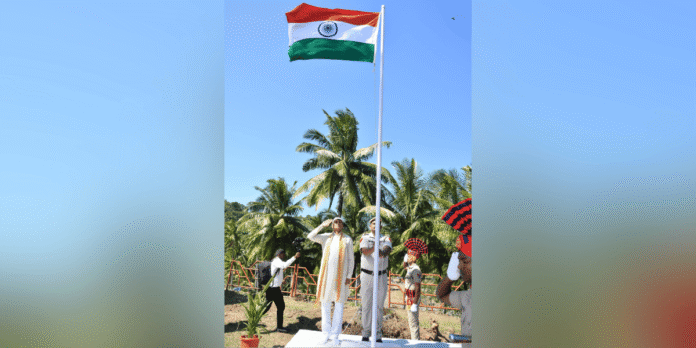
The national flag was hoisted at Viper Island on the occasion of the 77th Republic Day, with the ceremony drawing attention to the island’s historical association with India’s freedom struggle as well as its contemporary strategic significance in the Andaman and Nicobar Islands.
The flag hoisting was carried out by Union Minister of State for Home Affairs Nityanand Rai on January 26, marking an observance that linked a site of colonial-era incarceration with present-day national commemorations. Viper Island is among the earliest locations in the islands where the British colonial administration detained Indian freedom fighters before the construction of the Cellular Jail in Sri Vijaya Puram.
The island’s role during the colonial period has been documented as one marked by harsh conditions and confinement of those involved in the independence movement. The Republic Day ceremony at this location was positioned as a tribute to the sacrifices, hardships and resilience of freedom fighters who were held there. Hoisting the national flag at the site served as a symbolic gesture acknowledging that legacy within the broader framework of national remembrance associated with Republic Day.

Beyond its historical associations, the event also underscored the maritime and territorial dimensions of the Andaman and Nicobar Islands. The flag hoisting at Viper Island was presented as reflecting India’s sovereignty and its commitment to safeguarding maritime interests and coastal security in the region. The islands occupy a strategic position in the Bay of Bengal, and national events held at such locations are often linked to themes of maritime vigilance and territorial integrity.
The ceremony aligns with a broader initiative undertaken by the Andaman and Nicobar Administration in recent years to hoist the national flag on islands across the archipelago on occasions of national importance such as Independence Day and Republic Day. This campaign has been described as part of efforts to reinforce a sense of national presence and visibility across remote and sparsely inhabited islands.
According to official information, the campaign covers all 836 islands of the archipelago and has been implemented over the past few years in line with directions aimed at strengthening coastal security and national outreach in maritime regions. Observances at multiple island locations during national days form part of this ongoing exercise.

The Republic Day event at Viper Island thus combined historical commemoration with present-day administrative and security themes. While the primary focus remained on marking the adoption of the Constitution and national unity, the choice of venue highlighted the layered history of the islands, from sites of colonial detention to their present role in India’s strategic and maritime landscape.
Ceremonial activities at heritage-linked locations in the islands have increasingly drawn attention to the region’s role in the freedom struggle, alongside its strategic importance. Events such as the flag hoisting at Viper Island contribute to integrating historical memory with contemporary national observances, particularly in territories that are geographically distant from the mainland but hold distinct historical and geopolitical relevance.
The Republic Day ceremony at the island formed part of the broader celebrations held across the Union Territory, where official functions and commemorative activities were organized to mark the occasion.