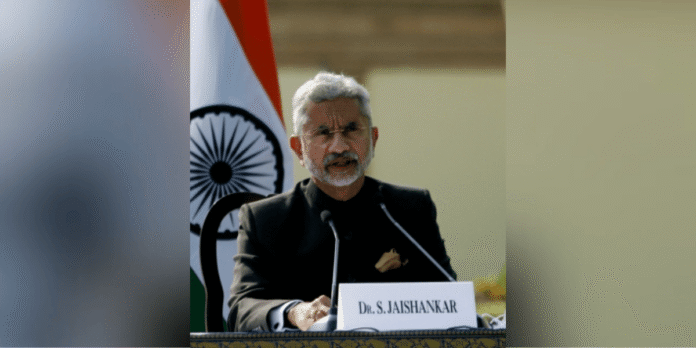
India’s External Affairs Minister S. Jaishankar has welcomed the US–India trade deal announced following talks between Prime Minister Narendra Modi and US President Donald Trump, describing it as a significant step towards creating jobs, driving economic growth and strengthening innovation in both countries.
Jaishankar said the agreement would deepen economic cooperation and provide a stronger foundation for the broader strategic partnership between New Delhi and Washington. In a post on X, he said the deal would generate employment opportunities, accelerate growth and promote innovation across sectors in both economies. He also noted that the agreement would reinforce the “Make in India” initiative while encouraging trusted technology partnerships.
“A robust economic relationship is the strongest foundation for our strategic partnership,” Jaishankar said, underscoring the importance of trade and technology collaboration in shaping bilateral ties.

The minister arrived in New York on Monday for a three-day official visit to attend the Critical Minerals Ministerial, which is being hosted by US Secretary of State Marco Rubio. The visit comes amid growing engagement between the two countries on supply chains, advanced technologies and strategic minerals seen as vital for future industries.
The trade agreement has drawn reactions from political commentators, policy experts and public figures in both countries, reflecting wide interest in the evolving US–India relationship. American singer and commentator Mary Millben described the deal as a moment of reconciliation, saying it demonstrated the power of humility in diplomacy. She thanked President Trump for restoring ties with Prime Minister Modi and praised India’s leadership during what she described as months of uncertainty.
Millben said the outcome positioned India strongly in global geopolitics and expressed confidence in the long-term prosperity of the US–India partnership. She added that the agreement signalled renewed trust and cooperation between the two democracies.
Khanderao Kand, chief of policy and strategy at the Foundation for India and Indian Diaspora Studies, also welcomed the agreement, crediting both leaders for giving fresh momentum to bilateral ties. He said the deal reaffirmed the central role of the US–India partnership in the Indo-Pacific region.

According to Kand, the agreement clears the way for progress under the TRUST framework and advances cooperation in emerging and strategic sectors such as artificial intelligence, quantum technology, cybersecurity, robotics, space and defence. He also pointed to deeper engagement through multilateral groupings including the Quad and I2U2, which he said would benefit from the renewed momentum in bilateral relations.
Political commentator Javed Hassan said India secured a more favourable tariff outcome compared to Pakistan, without resorting to symbolic gestures. His remarks added to the broader political debate surrounding the implications of the deal for regional trade dynamics.
Officials on both sides have indicated that the agreement is expected to deepen cooperation across economic, strategic and technology domains in the coming months. The trade deal is seen as a key pillar in strengthening the overall US–India partnership at a time of shifting global supply chains and geopolitical realignments.