The United States and Australia have entered into a new critical minerals agreement, strengthening cooperation on rare earths and other key resources just days after China announced export controls on rare earth minerals, magnets, and related products.
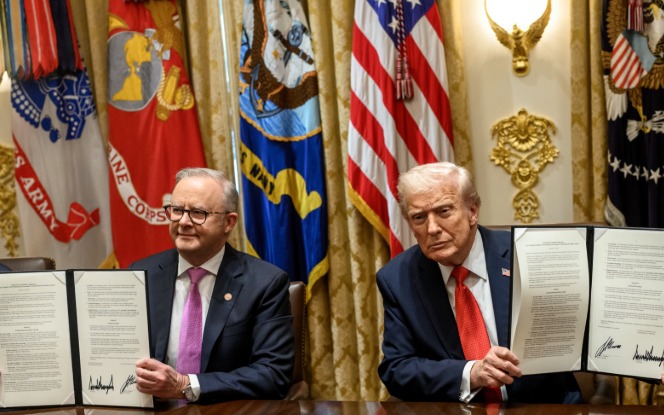
The deal was formalised during Australian Prime Minister Anthony Albanese’s visit to the White House, where he was hosted by U.S. President Donald Trump. The agreement aims to secure the supply chain for rare earth elements and reduce dependence on China, which currently dominates the global market for these strategic materials.
Trump highlighted the growing partnership between the two nations, particularly in the area of critical minerals. “We work together very much on rare earths, critical minerals, and lots of other things. We’ve had a very good relationship and have been working on that for quite a while,” the U.S. President said. “In about a year from now, we’ll have so much critical mineral and rare earths that you won’t know what to do with them. They’ll be worth $2 billion.”
Prime Minister Albanese praised the agreement, calling it a “significant step” that would elevate the bilateral relationship to the “next level.” The accord is expected to boost investments in mining, processing, and export infrastructure, with a focus on ensuring secure supplies of materials vital for clean energy technologies, semiconductors, and defence applications.
In addition to the minerals pact, Trump reaffirmed his administration’s commitment to the AUKUS defence alliance involving Australia, the United Kingdom, and the United States. The trilateral security pact, first signed in 2021, is designed to enhance Indo-Pacific security and deter regional threats.

Trump described the AUKUS initiative as a “deterrent” against China, noting that the project, which had seen delays, would now move forward more rapidly. “It was made a while ago, and nobody did anything about it. It was going too slowly. We do actually have a lot of submarines, the best in the world, and we’re building a few more currently under construction,” he said, adding that the process is now progressing “very rapidly.”
Under AUKUS, the U.S. is set to provide at least three nuclear-powered submarines to Australia in the 2030s, followed by the joint development of a new generation of submarines with the U.K. in the 2040s.
Trump also commented on the U.S.-China relationship, expressing optimism about an upcoming meeting with Chinese President Xi Jinping at the Asia-Pacific Economic Cooperation (APEC) Summit in South Korea. “We have a very good trade relationship. I think we’ll end up with a very strong trade deal. Both of us will be happy,” Trump said.
However, he warned of possible 100 per cent tariffs on Chinese products starting November 1 if Beijing proceeds with its export restrictions. On Taiwan, Trump downplayed the possibility of a Chinese invasion, asserting that “China doesn’t want to do that.” He emphasised that the U.S. remains “the strongest military power in the world by far.”