The Union Cabinet on Sunday approved the Union Budget 2026–27 at a meeting held in Parliament, setting the stage for a policy roadmap that blends high public investment, reform continuity and a renewed focus on inclusive growth. The meeting, chaired by Prime Minister Narendra Modi at Sansad Bhawan, cleared the Budget before Finance Minister Nirmala Sitharaman proceeded to present it in the Lok Sabha.
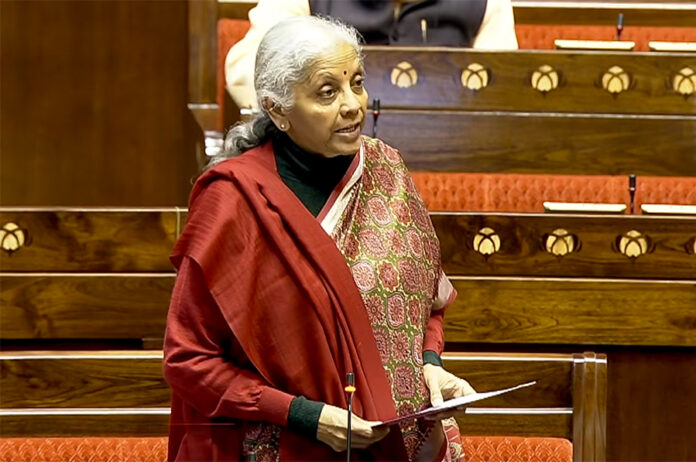
Before the presentation, the Finance Minister met President Droupadi Murmu at Rashtrapati Bhavan and offered her a copy of the digital Budget. In a traditional gesture, the President offered ‘dahi-cheeni’ to Sitharaman. The Minister was seen carrying her now-familiar ‘bahi-khata’, a red pouch containing a digital tablet with the national emblem, symbolising the government’s shift towards a paperless, eco-friendly Budget process first adopted in 2021. Sitharaman, presenting her ninth consecutive Union Budget, wore a deep maroon Kanjeevaram saree from Tamil Nadu, accompanied by Minister of State for Finance Pankaj Chaudhary, Chief Economic Advisor V. Anantha Nageswaran, CBDT Chairman Ravi Agrawal, and other officials.
In her address, Sitharaman framed the Budget around three key ‘Kartavyas’ or duties that she said would guide India’s economic direction. The first, she noted, is to accelerate and sustain economic growth by enhancing productivity, competitiveness and resilience amid volatile global dynamics. The second focuses on fulfilling people’s aspirations and building their capacities so they become active partners in India’s prosperity journey. The third, aligned with the vision of ‘Sabka Saath, Sabka Vikaas’, seeks to ensure that every family, community, region and sector has access to resources.

She said the government’s “Reforms Express” would maintain momentum, underlining that over 350 reforms have already been rolled out to boost productivity, employment and long-term growth. The Budget, she indicated, balances ambition with inclusion as India advances towards its ‘Viksit Bharat’ goal.
A central highlight of the Budget is a sharp thrust on infrastructure, with capital expenditure pegged at Rs 12.2 lakh crore for 2026–27. The allocation is aimed at accelerating big-ticket projects in highways, ports, railways and power, with the stated objective of driving growth and job creation. An Infrastructure Risk Development Fund will be set up to help speed up large projects by addressing financial and execution risks.
Sitharaman said the government has maintained fiscal prudence and monetary stability while sustaining strong public investment. She stressed that India must remain deeply integrated with global markets, step up exports and attract foreign investment to support expanding trade and capital requirements.
The Budget outlines interventions across six broad areas: scaling up manufacturing in strategic and frontier sectors; rejuvenating legacy industrial sectors; creating champion MSMEs; delivering a powerful push to infrastructure; ensuring long-term security and stability; and developing city economic regions as growth hubs. Manufacturing expansion in seven strategic sectors is seen as a priority under the first ‘Kartavya’, reflecting a push for self-reliance combined with global competitiveness.
New technologies, including artificial intelligence, were cited as potential growth multipliers that are transforming production systems even as they increase demand for water, energy and critical minerals. The policy approach, Sitharaman suggested, is to stay adaptive and forward-looking amid structural shifts in the global economy and geopolitical flux.

Economists expect the Budget to strike a careful balance between sustaining growth momentum and continuing fiscal consolidation. With geopolitical uncertainties shaping trade, energy and supply chains, capital expenditure in strategically important sectors is likely to remain a key lever. Unlike the previous Budget, which leaned more towards stimulating middle-class consumption through tax reliefs, this year’s approach to boosting consumption is expected to be more selective, while keeping the emphasis on investment-led growth.
The framing of the Budget in Kartavya Bhavan was described as symbolically linked to duty and responsibility, themes that ran through the Finance Minister’s speech. The overall message signals continuity in reform, a strong infrastructure push and a broad-based development agenda that seeks to combine economic expansion with social inclusion.
As India navigates global headwinds and domestic aspirations, the Union Budget 2026–27 lays out a roadmap that hinges on capital spending, structural reforms and capacity-building, an approach the government believes will sustain growth while extending opportunities across regions and sectors.