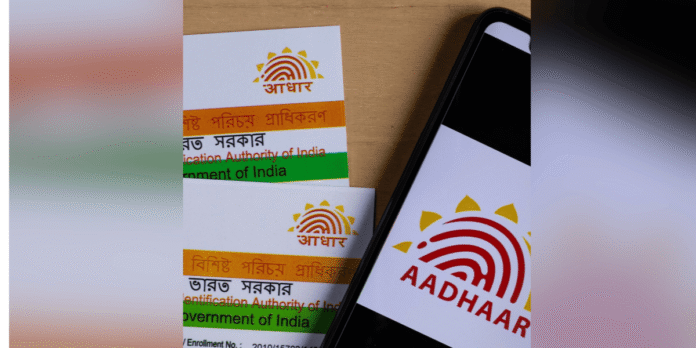
New Delhi, June 16: The Supreme Court on Tuesday agreed to examine a Public Interest Litigation (PIL) challenging the use of Aadhaar as proof of citizenship, domicile, residence and date of birth, while issuing notices to the Union government, states, Union Territories, the Election Commission of India and the Unique Identification Authority of India (UIDAI).
A Bench comprising Surya Kant and V. Mohana took up the petition and sought responses from the concerned authorities. The matter has been scheduled for further hearing on August 7.
The petition, filed by advocate Ashwini Kumar Upadhyay, seeks directions to ensure that Aadhaar is used strictly as a proof of identity and not for purposes that, according to the plea, go beyond the scope defined under the Aadhaar Act, 2016.
At the heart of the case is Section 9 of the Aadhaar Act, which the petitioner argues clearly states that Aadhaar is not evidence of citizenship or domicile. The plea further contends that notifications issued by the Unique Identification Authority of India have repeatedly clarified that Aadhaar serves only as proof of identity and not as proof of citizenship, address or date of birth.
Despite these provisions, the petition claims that Aadhaar continues to be widely accepted for purposes that include establishing age, residence and domicile in a range of administrative and legal processes.
According to the PIL, Aadhaar is frequently used during school admissions, property transactions, issuance of birth certificates, ration cards, driving licences and other official procedures where proof of residence or date of birth may be required.
A key aspect of the challenge concerns voter registration procedures. The petition specifically questions the use of Aadhaar as proof of date of birth and residence in Form-6, which is used for new voter enrolment.
The petitioner argues that permitting Aadhaar to serve these functions is inconsistent with the provisions of the Aadhaar Act, UIDAI guidelines and the legal framework governing elections under the Representation of the People Act.
The PIL seeks directions requiring the Centre, state governments and the Election Commission of India to adopt measures ensuring that Aadhaar is used only for identity verification and not as a substitute for documents establishing citizenship, domicile or age.
The petition also draws attention to the Aadhaar enrolment framework, noting that the document is issued to residents rather than exclusively to citizens. Under existing rules, individuals residing in India for a prescribed period may be eligible to enrol for Aadhaar.
According to the plea, this distinction is important because Aadhaar was designed as an identity authentication tool and not as evidence of citizenship status.
The petitioner further argues that weaknesses in document verification during enrolment could allow individuals who are not legally entitled to certain benefits to obtain Aadhaar and subsequently use it as a foundational document to secure additional identity and entitlement documents.
The petition claims that such practices could affect the integrity of welfare distribution systems and lead to the diversion of benefits intended for eligible beneficiaries. It contends that this raises concerns relating to fairness, targeted welfare delivery and administrative accountability.
The PIL seeks a declaration that the use of Aadhaar as proof of date of birth and residence in voter registration processes is legally unsustainable. It also requests that any such usage be declared void and inoperative.
The Supreme Court’s decision to issue notices does not amount to a ruling on the merits of the case. Instead, it signals the beginning of judicial examination of the issues raised in the petition.
The responses of the Union government, state administrations, the Election Commission and UIDAI are expected to play a key role in shaping the proceedings when the matter returns before the court in August.
The case is likely to attract considerable attention as it touches upon the legal scope of Aadhaar, the distinction between identity and citizenship documentation, and the role of digital identity systems in governance and public administration.