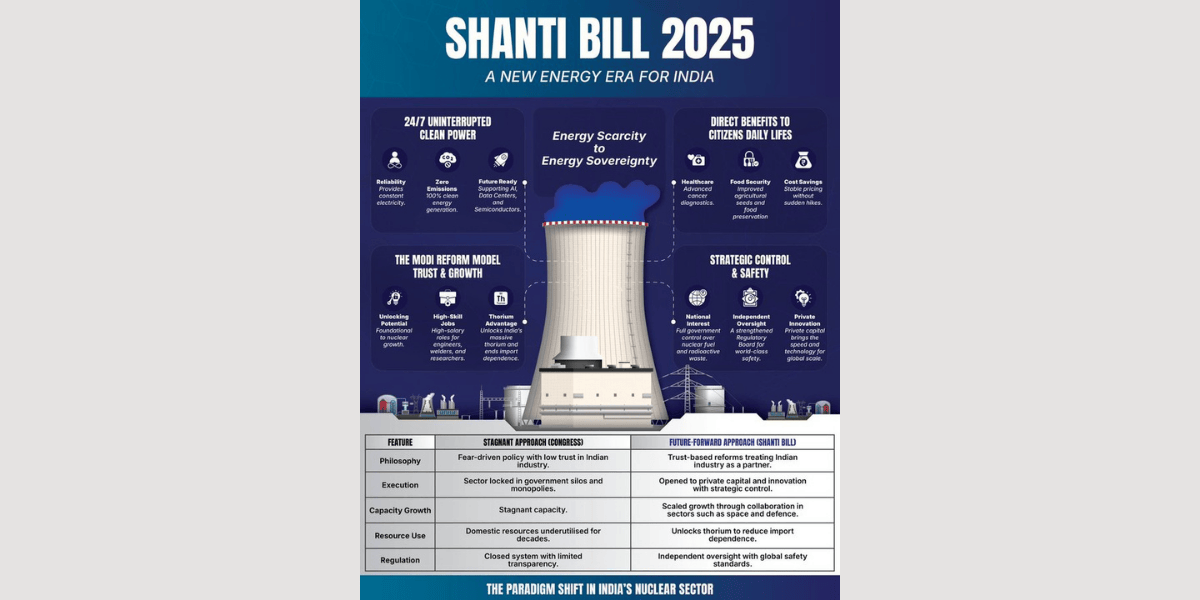
Parliament has passed the Sustainable Harnessing and Advancement of Nuclear Energy for Transforming India (SHANTI) Bill, 2025, paving the way for a major overhaul of India’s nuclear energy framework with the aim of achieving self-reliance and meeting long-term clean energy targets by 2047.
Cleared by both the Lok Sabha and the Rajya Sabha, the legislation seeks to create an enabling ecosystem for clean, reliable nuclear energy while reaffirming India’s long-standing commitment to the peaceful use of atomic power and adherence to global best practices in nuclear governance.
A key feature of the Bill is the controlled opening of the nuclear sector to private and joint venture participation. The move is intended to address resource constraints, reduce project gestation periods, and support the national goal of achieving 100 GW of nuclear capacity by 2047, without compromising national security or public interest.

The proposed law consolidates and rationalises provisions from the Atomic Energy Act, 1962, and the Civil Liability for Nuclear Damage Act. It also accords statutory status to the Atomic Energy Regulatory Board, integrating it into the parent legislation and strengthening regulatory oversight.
While the Bill enables private participation, it draws clear boundaries around strategic and sensitive areas. Uranium mining beyond specified thresholds will remain exclusively under government control. Spent fuel management will continue to be handled solely by the government under defined long-term storage and handling protocols. Strategic materials, including source material, fissile material and heavy water, will also remain under strict state custody.
The legislation explicitly expands the definition of nuclear damage to include environmental and economic harm. Dedicated investments have been announced for small modular reactors, research and innovation, aimed at building a robust and future-ready nuclear ecosystem.
Beyond electricity generation, the Bill recognises the wider applications of nuclear energy in healthcare, agriculture and industry. The expanded framework is expected to support rising demand from sectors such as data processing, healthcare services and industrial applications, alongside renewable energy sources.

Addressing safety concerns during the Lok Sabha debate, Union Minister of Science and Technology Jitendra Singh said nuclear safety standards would remain unchanged and uncompromised. He reiterated that operations would continue to be governed by the principle of “safety first, production next,” as enshrined in the Atomic Energy Act of 1962.
The safety framework includes quarterly inspections during construction, biannual inspections during operation, five-yearly licence renewals, and enhanced regulatory powers for the now-statutory Atomic Energy Regulatory Board. Oversight mechanisms are aligned with International Atomic Energy Agency parameters. The government also noted that India’s nuclear plants are located away from major seismic fault zones and that radiation levels at Indian reactors remain well below global safety limits.
Operationally, the Bill lays down clear provisions for licensing and safety authorisation for entities involved in nuclear energy production or use, along with defined grounds for suspension or cancellation. It brings the use of nuclear and radiation technologies in healthcare, food and agriculture, industry and research under regulation, while exempting research and innovation activities from licensing requirements.
The legislation also proposes a revised civil liability framework and new institutional mechanisms, including an Atomic Energy Redressal Advisory Council, Claims Commissioners and a Nuclear Damage Claims Commission for severe cases, with the Appellate Tribunal for Electricity designated as the appellate authority.
Linked to India’s decarbonisation roadmap towards net-zero emissions by 2070, the SHANTI Bill seeks to balance nuclear expansion with safety, accountability and public interest within the broader push for energy security and a lower-carbon future.