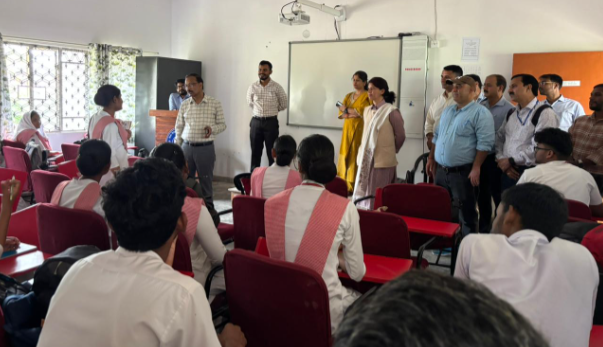
A delegation from the State Council of Educational Research and Training, Uttarakhand, visited the District Institute of Education and Training in the Andaman and Nicobar Islands as part of a three-day academic exposure programme held from January 19 to 21. The visit was organised with the objective of strengthening inter-state academic collaboration and facilitating the exchange of best practices in the field of teacher education.
The exposure programme provided the visiting team with an opportunity to gain firsthand understanding of the academic, administrative and training processes followed at DIET Andaman and Nicobar. During the visit, extensive interactions were held between the visiting delegation and faculty members of DIET A&N, as well as teacher trainees enrolled in various programmes. These discussions focused on pedagogical innovation, training management strategies and curriculum implementation aligned with the National Education Policy 2020.
A key area of focus during the interactions was Foundational Literacy and Numeracy, which has been identified as a priority under the National Education Policy. Faculty members shared their experiences in designing and delivering training modules aimed at strengthening early learning outcomes. The visiting team observed classroom teaching-learning processes and reviewed academic support mechanisms used to enhance teacher professional development.
The programme also provided insights into how DIET A&N adapts national frameworks to the unique geographical and cultural context of the islands. The visiting team took note of initiatives aimed at integrating local culture, traditions and heritage into the teaching-learning process. These practices were highlighted as contributing to more contextual, inclusive and meaningful education for students in island communities.
Faculty members of DIET Andaman and Nicobar shared their experiences in implementing teacher training programmes under Samagra Shiksha. Discussions covered challenges related to geographic dispersion, access to resources and logistics, as well as strategies adopted to ensure continuity and quality of training across remote areas. Innovative practices developed to address island-specific needs were presented during the interactions.
The visiting delegation comprised senior academic officers, principals and lecturers from SCERT Uttarakhand. The team was led by the Additional Director of SCERT Uttarakhand. The structured engagement allowed both institutions to exchange perspectives on teacher education, curriculum delivery and professional development in diverse settings.
The exposure programme was designed to promote mutual learning and collaboration between institutions operating in different regional contexts. By observing each other’s practices and engaging in detailed discussions, the programme aimed to identify scalable models and adaptable strategies that could strengthen teacher education systems in both regions.
Officials associated with the programme indicated that such inter-state academic exchanges play an important role in building institutional capacity and fostering innovation in teacher training. The visit also highlighted the importance of collaboration in achieving national education goals under NEP 2020, particularly in areas such as foundational learning and teacher preparedness.
The three-day programme concluded with an emphasis on continued engagement and knowledge-sharing between SCERT Uttarakhand and DIET Andaman and Nicobar. The academic exchange was seen as a step towards strengthening professional networks and enhancing the quality of teacher education through shared learning and cooperation.