A high-level team of officials from the Andaman & Nicobar Administration visited Little Andaman on October 15 and 16 to conduct a comprehensive assessment of pest infestation in Arecanut plantations and to engage with Panchayati Raj Institutions (PRIs) on key developmental issues affecting the island.
Constituted under the directions of the Chief Secretary, the team included Rajesh Chopra (IAS), Secretary (Cooperation) and Registrar of Cooperative Societies, Dr. Apurva Sharma, Director (RD/Panchayats/PRI), Mohit, Subject Matter Specialist (KVK, CIARI, SVP), and Navashakti, Assistant Director (Agriculture). The officials visited several villages , V.K. Pur, R.K. Pur, Rabindra Nagar, Netaji Nagar, and Harminder Bay , interacting with farmers, PRI members, and community leaders to understand agricultural and infrastructural challenges firsthand.
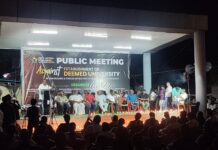
During the visit, the team focused on examining the extent of pest damage in Arecanut and Coconut plantations, which form the backbone of local livelihoods. On the first day, the officials held an interactive session at the Community Hall, V.K. Pur, attended by local farmers, panchayat representatives, and the public. Farmers shared detailed accounts of recurring pest problems, declining yields, and the need for timely supply of agricultural inputs and fertilizers.

Officials emphasized the Administration’s commitment to addressing these concerns through scientific pest management, improved logistics, and farmer outreach. The session also shed light on historical pest patterns, inadequate fertilizer supply, and limited awareness of sustainable agricultural practices.
On the second day, the team visited Harminder Bay Tribal Village, where interactions with the Tribal Council Secretary and the Captains revealed a contrasting picture , the community reported no major pest issues, crediting their success to organic practices and proper spacing between coconut palms. Their methods, which avoid chemical fertilizers and pesticides, have helped maintain healthy yields sold to private traders.
Later, a meeting was held at Panchayat Samiti, Hut Bay, where S. Parmanathan, Pramukh of Little Andaman, highlighted the administration’s ongoing efforts to mitigate pest-related challenges. Farmers reiterated concerns regarding delays in input distribution and requested standardized procedures to streamline agricultural support.
Officials assured the gathering that Standard Operating Procedures (SOPs) and technical documents would be developed by CIARI and the Agriculture Department to strengthen pest control mechanisms and enhance coordination between departments.
Beyond agriculture, the field visit also became a platform for addressing broader developmental concerns raised by PRIs and local residents. Among the issues discussed were the reduced gas cylinder supply (cut from 12 to 6 per household annually), stray cattle menace, shortage of construction materials, frequent streetlight failures, and deteriorating bus stands due to funding shortages.
To address the twin problems of stray cattle and energy scarcity, the team proposed establishing Gowshalas and biogas plants under the MNRE Scheme, along with reviving dairy cooperatives to boost local livelihoods. Officials also discussed ways to resolve discrepancies in public works planning caused by the use of different DSR guidelines (2021 vs 2023) between departments.
Emphasizing financial self-reliance, the team advised all panchayats to develop their own funds by collecting rent from community assets and infrastructure. The Self-Help Groups (SHGs) were encouraged to participate in regular training programs under the National Rural Livelihood Mission (NRLM) to improve capacity building and income generation.
The two-day field mission concluded with the team reaffirming the Administration’s commitment to supporting sustainable agriculture and local development in Little Andaman. The collaborative approach , involving agricultural scientists, administrative officers, and community representatives , is expected to result in more targeted interventions for pest control and rural welfare.
The Administration has assured continued coordination with farmers and PRI institutions to implement scientific pest management solutions and address long-standing developmental concerns, ensuring that the island’s farming and rural communities remain resilient and self-sustaining.