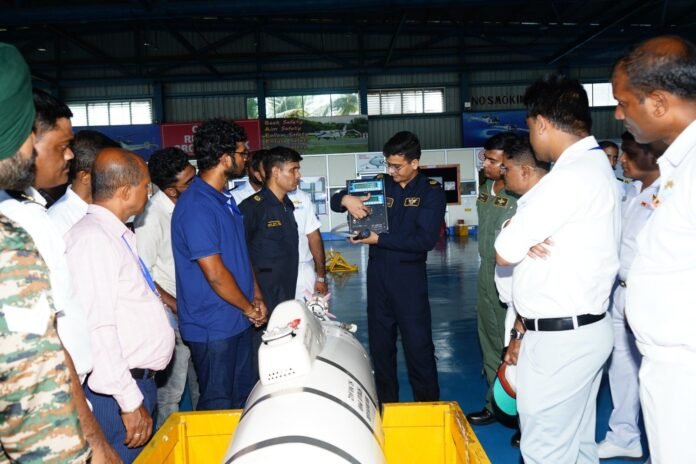
Sri Vijaya Puram, Aug. 26: A six-day training programme on Oil Pollution Response (OPR) and handling Hazardous and Noxious Substances (HNS) was conducted in Sri Vijaya Puram to strengthen preparedness for marine pollution incidents and improve coordination among agencies responsible for responding to emergencies at sea.
The programme, organised by the Pollution Response Team of Sri Vijaya Puram, brought together personnel from multiple departments and security agencies involved in maritime safety, environmental protection, emergency response and disaster management.
Participants included Indian Coast Guard personnel and representatives from the Andaman and Nicobar Command (ANC), Andaman and Nicobar Police, Police Marine Force, Forest Department, Fire Services Department, Directorate of Shipping Services and Directorate of Disaster Management.
The training covered the Oil Pollution Response Course (OPRC) Level 1 and an introductory course on Hazardous and Noxious Substances. The programme focused on strengthening practical response capabilities and ensuring that agencies involved in marine emergencies can work together effectively during an oil spill or an incident involving hazardous substances.
For the Andaman and Nicobar Islands, such preparedness assumes particular importance because of the Union Territory’s sensitive marine ecosystem and its location near major international shipping routes. The islands are situated close to the Strait of Malacca, one of the world’s key maritime corridors through which substantial volumes of global seaborne trade pass.
The islands also depend heavily on ships and ferries for transportation and connectivity. Consequently, an accident involving a vessel, fuel leakage or a hazardous-substance spill could pose risks not only to maritime operations but also to coastal ecosystems and marine biodiversity.
Oil spills can have long-lasting consequences for marine environments, affecting water quality, beaches, mangroves, coral ecosystems, fisheries and other forms of marine life. In an ecologically sensitive region such as the Andaman and Nicobar Islands, the ability to respond quickly can therefore be critical in limiting the spread and impact of pollution.
The training was conducted in line with the broader international framework for marine pollution preparedness and response. The International Maritime Organization (IMO) has developed model courses for oil pollution preparedness, response and management following the International Convention on Oil Pollution Preparedness, Response and Co-operation, 1990, commonly known as the OPRC Convention.
The convention calls for governments to establish programmes for exercises and training of personnel involved in oil pollution response. It also provides for international cooperation and the development of training programmes to strengthen national response capabilities.
The IMO’s OPRC model courses cover different levels of competency. Level 1 is designed for first responders who may be required to take immediate action during a marine oil pollution incident.
The training framework is intended to complement national contingency arrangements, allowing personnel responsible for responding to marine pollution to develop the operational knowledge required to contain and manage incidents.
The programme in Sri Vijaya Puram also addressed hazardous and noxious substances, which present a different set of challenges from conventional oil spills. Such substances can pose risks to human health, marine ecosystems and emergency responders, requiring specialised knowledge and coordinated action.
The OPRC-HNS Protocol, adopted in 2000, similarly calls for governments to establish appropriate training and exercises for personnel involved in responding to pollution incidents involving hazardous and noxious substances.
The IMO has subsequently developed model training courses dealing with preparedness and response to marine incidents involving HNS. These courses are intended to provide practical guidance and complement existing oil pollution response training.
The Andaman and Nicobar Command said the six-day programme included hands-on training in oil spill response and HNS spill management. The Command said the training enhanced operational skills, preparedness, teamwork and inter-agency coordination, with the objective of enabling a swift and effective response to marine pollution incidents.
The participation of agencies ranging from the Coast Guard and military command to police, fire services, forest authorities, shipping officials and disaster management personnel highlights the multi-agency nature of marine pollution emergencies.
A major spill or hazardous-substance incident may require simultaneous action involving containment, firefighting, evacuation, maritime traffic management, environmental assessment, shoreline protection and disaster response. Effective coordination between agencies can consequently determine how quickly an incident is brought under control.
The training programme therefore represents an important preparedness measure for the islands, where protecting the marine environment is closely linked to the region’s ecology, economy, transportation network and coastal communities.