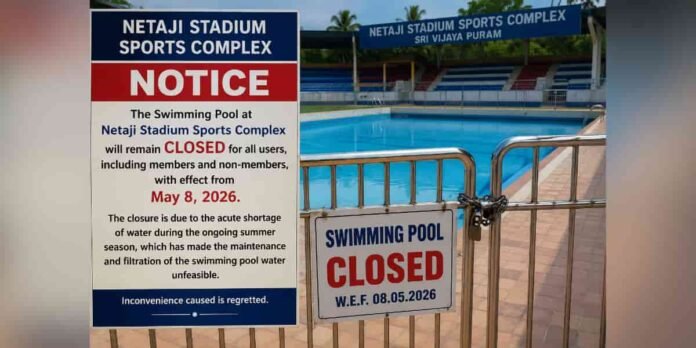
Sri Vijaya Puram, May 8: For generations growing up in the Andaman and Nicobar Islands, learning to swim was never just a sport. It was a rite of passage. From village creeks and sea-facing jetties to the lanes of the Netaji Stadium Swimming Pool, swimming has long remained one of the Islands’ most cherished childhood memories, a skill tied as much to survival as to joy.
But this summer, that memory is once again being put on hold.
The swimming pool at the Netaji Stadium Sports Complex in Sri Vijaya Puram has been closed indefinitely from May 8 due to acute water shortage, leaving hundreds of trainees, school students, recreational swimmers and athletes without access to one of the Islands’ most frequently used sports facilities.
Authorities cited difficulties in maintaining filtration systems, hygiene standards and adequate water levels amid the ongoing summer scarcity. Officials said the closure would continue until the water supply situation improves.

Yet, beyond the official notification lies a larger and increasingly frustrating question that returns every summer: how does a region surrounded by water and blessed with nearly six to eight months of rainfall continue to collapse into crisis during a few dry months every year?
The closure of the pool has once again brought attention to the repetitive cycle of temporary restrictions instead of long-term water management planning.
Every summer, notices on water conservation, supply cuts and restrictions become routine across the Islands. Despite years of recurring shortages, visible progress towards creating sustainable storage and supply systems capable of handling seasonal demand continues to remain limited.
The issue no longer appears to be merely about scarcity, but about planning.
Measures such as desilting existing reservoirs, increasing storage capacity, restoring abandoned or underutilised dams, improving rainwater harvesting infrastructure and modernising water distribution systems have repeatedly been discussed as practical long-term solutions.
The Islands receive substantial rainfall compared to several mainland regions that continue to manage water demands through stronger storage and conservation systems. The recurring shortages during a few summer months continue to raise questions over preparedness and long-term planning.
The closure particularly affects young trainees and school-going children who depend on the Netaji Stadium facility for professional swimming lessons and sports training. For many families in Sri Vijaya Puram, the stadium pool remains among the few accessible spaces for structured swimming education.
Several children are expected to lose months of training during the summer vacation period, traditionally the time when most students enrol for swimming classes.
Swimming at the stadium has long remained associated with childhood in the Islands, where generations grew up learning the skill as both recreation and necessity in a sea-bound territory.

Sports authorities maintained that the decision was necessary in the interest of hygiene, public safety and responsible use of limited resources. Officials stated that maintaining pool sanitation without adequate water could pose health risks.
The administration has also been implementing water conservation measures across urban areas as demand rises during the summer months.
Still, the annual recurrence of shortages continues to raise concerns over the absence of a future-ready approach towards water security in the Islands.
For now, the gates of the Netaji Stadium pool remain shut, and with them, another season of childhood memories, swimming lessons and aspirations has quietly gone dry.