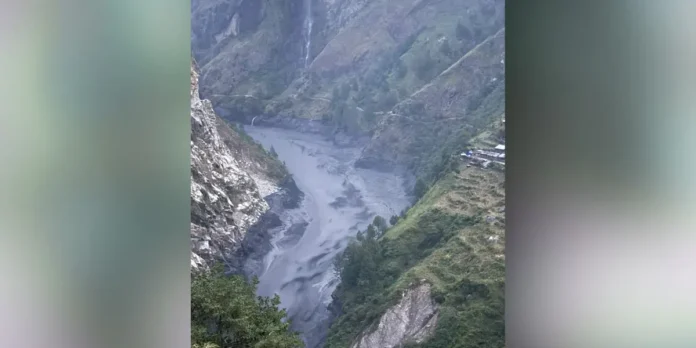
Kathmandu, October 14: A massive landslide in Nepal’s Gorkha district unleashed energy equivalent to a magnitude-3.5 earthquake and triggered repeated flood surges in the Budhi Gandaki River, with the largest reaching an estimated height of 20 to 25 metres, according to a preliminary assessment by the Department of Mines and Geology.
The disaster struck early on October 11 after an avalanche and landslide sent snow, water and debris down the upper reaches of the Ungdilung Khola, a tributary of the Budhi Gandaki. The resulting debris repeatedly blocked and released river flows, producing destructive surges downstream, the technical assessment said.
Nepal’s National Disaster Risk Reduction and Management Authority (NDRRMA), citing the assessment, reported that at least five people were missing and several hydropower projects, roads and bridges had been destroyed.

The incident occurred at around 4.20 am between Chamar Himal and Syerangi Himal in Chumnubri Rural Municipality, which borders China. The avalanche originated at an altitude of approximately 6,000 metres in the Tibetan Tethys Himalaya, where rock formations are relatively weak, before a landslide developed at around 5,500 metres.
The debris moved south along the Ungdilung Khola and accumulated at the narrow confluence with the Syar Khola, another tributary of the Budhi Gandaki, at an altitude of about 2,000 metres. Repeated blockages and releases at the confluence likely generated successive flood surges. A similar process may have occurred farther downstream where the Syar Khola meets the Budhi Gandaki.
The first mud-laden surge reached Salleri at around 4.30 am, where a camp for the 341-MW Budhi Gandaki Hydroelectric Project stood. The largest surge arrived at approximately 6.30 am, reaching an estimated 20 to 25 metres and sweeping away the camp.

The flood also caused extensive damage in the Jagat area, affecting several buildings and damaging permanent bridges over the Soti Khola and Budhi Gandaki rivers.
The assessment attributed the largest surge primarily to the enormous volume of debris carried by the Ungdilung Khola, rather than water accumulated behind the Syar Khola blockage alone. Field observations indicated that the Syar Khola’s flow had stopped about an hour before the main surge arrived, leaving water accumulated over a stretch of roughly 1.5 kilometres upstream. Smaller surges continued after the largest wave passed.
The October 11 disaster followed major floods in the Bhote Koshi and Trishuli rivers on August 26. The NDRRMA said that earlier disaster killed nearly 1,500 people and left more than 5,000 missing, while damaging communities, homes, hydropower plants, roads and bridges.