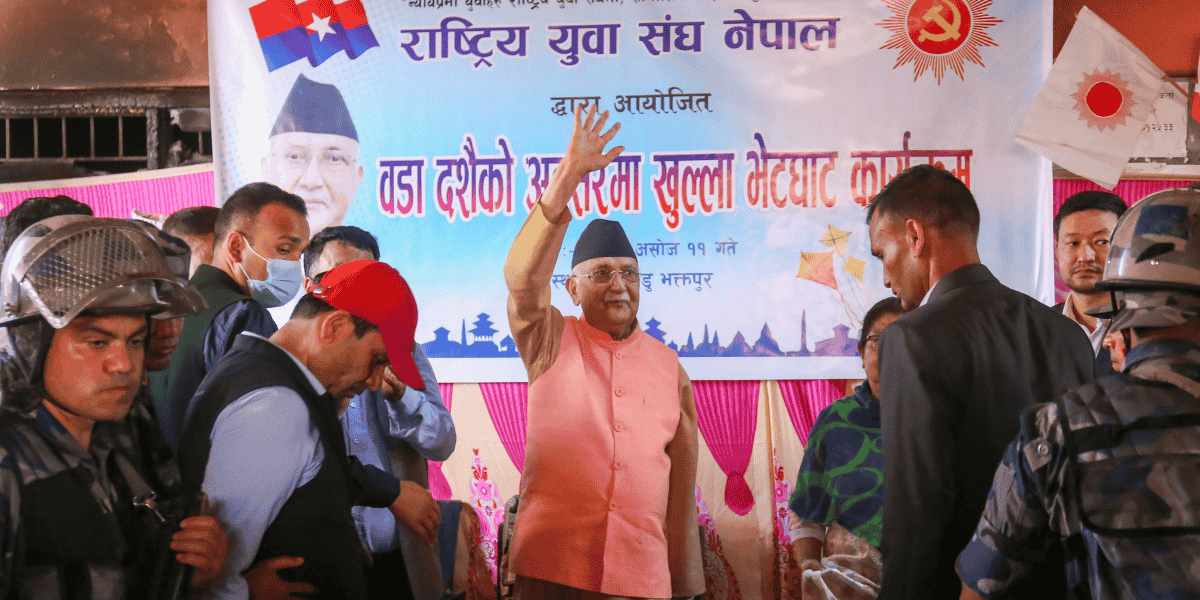
Communist Party of Nepal (Unified Marxist–Leninist) Chairperson K P Sharma Oli has secured a third consecutive term as the party’s leader after winning the election at the UML’s 11th general convention held in Kathmandu, despite having been ousted as Prime Minister in September.
According to the party’s Central Election Commission, Oli won 1,663 votes out of the 2,227 cast, defeating outgoing General Secretary Ishwor Pokharel, who secured 564 votes. The result allows Oli to continue leading Nepal’s second-largest political party for another five-year term.
Oli was first elected UML chairperson at the party’s ninth general convention in 2014 and was re-elected at the 10th general convention in 2021. His latest victory marks a hat-trick of wins for the party’s top post, further consolidating his authority within the UML at a time when his political leadership had come under scrutiny following the fall of his government.

The contest was notable for the internal divisions it exposed within the party. Pokharel, who mounted the first serious challenge to Oli’s leadership in more than a decade, received vocal backing from former President Bidya Devi Bhandari. Bhandari, who had expressed interest in returning to active party politics and leading the UML, was earlier denied party membership by Oli. Following that decision, she openly supported Pokharel’s bid for the chairmanship. However, her backing failed to shift the balance against Oli.
Pokharel’s political trajectory within the UML has seen several shifts. He was aligned with the faction led by former Prime Minister Jhala Nath Khanal during the party’s eighth general convention in 2009 but joined Oli’s camp during the ninth convention in 2014. In the 2021 convention, Pokharel had supported Oli against Bhim Rawal, who challenged Oli’s leadership at the time. Oli subsequently emerged unopposed amid the party’s split that year, when a faction led by Madhav Kumar Nepal broke away to form the CPN (Unified Socialist).
Since then, Oli has tightened his grip on the party, sidelining or forcing out several senior leaders, including Rawal, who were among his strongest internal critics. While the Gen-Z-led movement in September that led to the collapse of the Oli government triggered questions about his leadership within sections of the party, the convention outcome indicates sustained support for him among UML cadres.

Oli’s eligibility to contest the chairperson’s post was made possible through amendments to the party statute earlier this year. The statute convention held in September removed the two-term limit and the 70-year age ceiling for executive posts. Oli, now 73, would otherwise have been barred from contesting.
The UML had introduced a two-term limit at its eighth general convention in 2009, followed by an age cap of 70 years at the ninth convention in 2014. The age limit was first suspended at a secretariat meeting in June 2023, before both restrictions were formally scrapped at the statute convention.
The changes not only enabled Oli’s re-election but also helped many of his loyalists secure key positions within the party leadership. With this decisive mandate, Oli emerges from the convention with strengthened control over the UML, even as Nepal’s broader political landscape remains fluid following the dissolution of the House of Representatives.