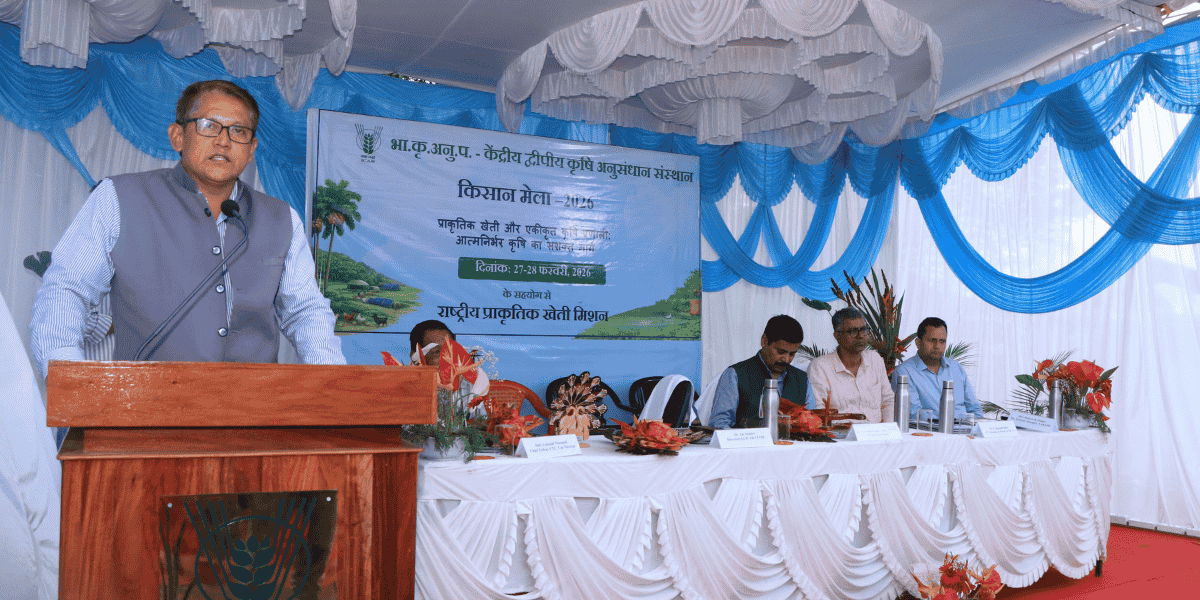
The Kisan Mela–2026 cum Exhibition concluded at the ICAR–Central Island Agricultural Research Institute in Sri Vijaya Puram, drawing participation from farmers, scientists, entrepreneurs and other stakeholders from across the Andaman and Nicobar Islands. The event served as a key platform for sharing agricultural innovations, strengthening farmer–scientist interaction and promoting climate-resilient farming practices suited to island conditions.
The concluding session of the Kisan Mela was chaired by senior representatives of the Indian Council of Agricultural Research, along with institutional leadership from ICAR–CIARI and community representatives. The programme brought together officials, scientists, farmers and students, reflecting a broad-based engagement with the agricultural sector in the islands.
The deliberations during the concluding session highlighted the unique agro-climatic challenges faced by island farmers, including heavy monsoon rainfall, seasonal water scarcity, cyclones and coastal erosion. These conditions, speakers noted, require location-specific technologies and adaptive farming practices distinct from those used on the mainland.

Emphasis was placed on the need to enhance farmers’ income through innovation, entrepreneurship and diversification of livelihood options. Discussions focused on attracting youth to agriculture by promoting agri-based enterprises and encouraging value addition to locally available resources. Participants were encouraged to explore opportunities that integrate agriculture with tourism, particularly through branding, packaging and marketing of island-specific products.
The potential for processing local produce such as coconut, honey, kokum and traditional Karen rice into value-added products was highlighted as a viable income-enhancing strategy. Suggestions included the development of products such as virgin coconut oil, juices and processed food items that can be marketed to tourists and consumers in mainland markets. The role of handicrafts and strong branding initiatives in complementing agricultural income was also discussed.
Officials from ICAR–CIARI noted that the two-day Kisan Mela witnessed active participation from more than 1,000 farmers, students and stakeholders. Exhibitions and technical interactions generated significant interest in high-quality planting materials, with several young participants expressing intent to take up nursery development and the production of planting materials as entrepreneurial ventures.
Post-harvest management emerged as a key theme during the event, particularly in the context of island agriculture where transportation constraints and perishability often affect farm income. The need for local processing and storage solutions was underscored as a means to reduce losses and improve market access.

As part of the Kisan Mela, a Fruits and Vegetables Competition was organised to encourage excellence in horticultural production. Farmers displayed a wide range of produce cultivated using improved agricultural practices. The competition was conducted in two categories, fruits and vegetables, and winners were recognised for the quality and diversity of their produce.
Earlier in the programme, officials from the Krishi Vigyan Kendras provided an overview of the activities conducted during the Kisan Mela, outlining the objectives of the exhibitions and technical sessions. The event concluded with acknowledgements to participating farmers, scientists and coordinating teams for their role in making the Kisan Mela a collaborative platform for agricultural advancement.
Organisers indicated that the technologies and practices showcased during the event are expected to be adopted and disseminated by farmers across the islands, reinforcing the role of ICAR–CIARI and its allied institutions in strengthening sustainable and income-oriented agriculture in the Andaman and Nicobar Islands.