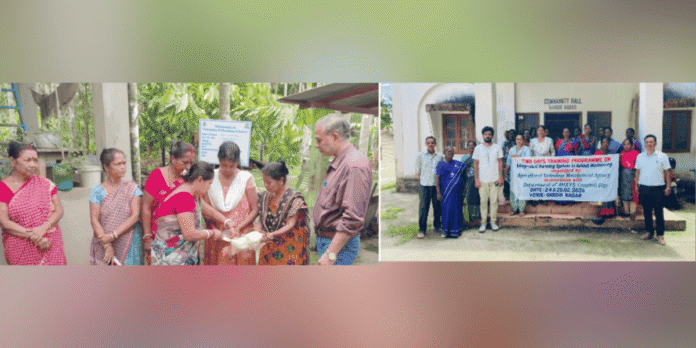
Efforts to strengthen sustainable livestock-based livelihoods gained momentum in South Andaman as the Department of Animal Husbandry and Veterinary Services, in collaboration with Agricultural Technology Management Agency and UTATMA, rolled out a series of capacity-building initiatives aimed at improving farm income, productivity, and animal health.
A two-day training programme on integrated farming systems in animal husbandry was organised at Gandhi Nagar, focusing on the scientific integration of livestock with crop cultivation. The programme highlighted resource recycling, dual-purpose farming models, and efficient utilisation of farm inputs to ensure year-round income generation for rural households. Participants were exposed to practical approaches that combine animal husbandry with agriculture, enabling farmers to optimise land, labour, and biological resources.

Officials associated with the programme said the emphasis was on creating resilient farming systems that are both environmentally sustainable and economically viable. Integrated models discussed during the sessions included linking livestock waste with crop nutrition, fodder cultivation alongside food crops, and balancing farm enterprises to reduce dependency on a single income source. The training witnessed active participation from farmers and is expected to encourage wider adoption of integrated practices across villages.
Complementing the classroom-based training, a field-level practical demonstration on vaccination and deworming in poultry was conducted at R K Pur in Hutbay. Organised by the Department of AH&VS in association with ATMA, the programme was held at a local farmer’s field and was attended by 15 participants, most of whom were members of self-help groups engaged in backyard poultry rearing.
During the live demonstration, participants were sensitised to the importance of timely vaccination and deworming to prevent disease outbreaks, reduce mortality, and maintain flock health. The session focused on common poultry diseases, preventive healthcare schedules, and the economic losses associated with neglecting scientific health management practices.
The demonstration also aimed to bridge the knowledge gap among small-scale poultry keepers by translating technical veterinary practices into simple, adoptable steps suitable for backyard systems. Participants were encouraged to view preventive healthcare as an investment rather than an expense, particularly in low-input poultry units where disease outbreaks can wipe out entire flocks.
To support adoption of scientific practices, poultry feed worth ₹3,200 was distributed among participants at the conclusion of the programme. In a related intervention, fodder stem cuttings were supplied to two dairy farmers to initiate backyard fodder plot development, aimed at reducing dependence on purchased feed and improving nutritional availability for livestock.
Officials indicated that such combined interventions,training, demonstrations, and input support, are designed to create measurable impact at the grassroots level. By linking knowledge dissemination with material assistance, the department seeks to ensure that recommended practices translate into sustained behavioural change among farmers.

The integrated approach adopted by the department aligns with broader efforts to enhance nutritional security and livelihood resilience in rural areas. Animal husbandry, when integrated effectively with agriculture, has been identified as a key driver for supplementary income, especially for small and marginal farmers, women-led self-help groups, and land-constrained households.
Department sources noted that enthusiastic participation in both the training programme and field demonstration reflected growing interest among farmers in diversified and science-based farming systems. Similar outreach activities are expected to be expanded to other locations in the coming months as part of ongoing efforts to strengthen the livestock sector in the islands.