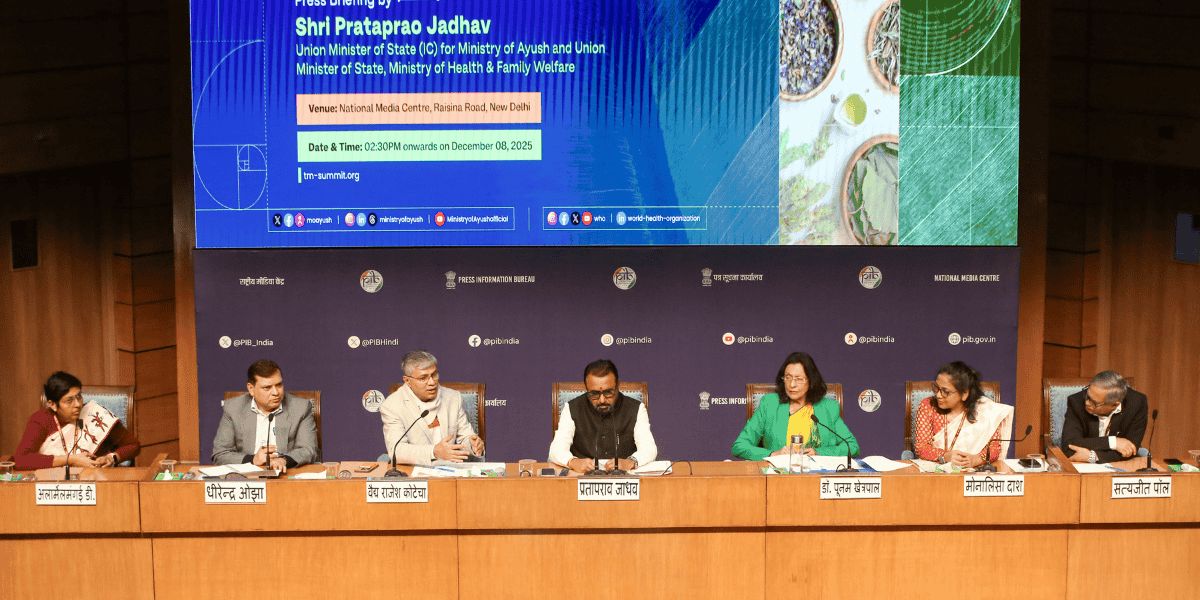
India is set to further consolidate its position as a global leader in traditional medicine as it hosts the second WHO Global Summit on Traditional Medicine from December 17 to 19 in the national capital. The summit comes at a time when traditional systems of medicine are increasingly being recognised worldwide for their role in holistic, preventive and person-centred healthcare.
According to the government, India’s extensive traditional knowledge base, combined with modern regulatory mechanisms, digital integration and scientific validation, has placed the country at the forefront of the global traditional medicine movement. The three-day summit will be held under the theme “Restoring Balance for People and Planet: The Science and Practice of Well-Being.”
A major highlight of the summit will be the launch of the WHO Traditional Medicine Global Library (TMGL), described as the world’s most comprehensive digital repository on traditional, complementary and integrative medicine. The library will host more than 1.5 million records, providing a centralised global platform for research, policy formulation and evidence-based practice in traditional medicine.

Official data reflects the scale of India’s traditional healthcare ecosystem. The country currently has 3,844 AYUSH hospitals, 36,848 dispensaries, 886 undergraduate colleges and 251 postgraduate institutions, along with over 7.5 lakh registered practitioners across various traditional systems. These figures underline India’s institutional capacity and long-standing reliance on traditional medicine as part of everyday healthcare.
The summit is also expected to reinforce India’s growing influence in shaping international discussions on standards, research frameworks and evidence-based integration of traditional medicine into modern health systems. The government said the event aligns with the broader vision of ‘Viksit Bharat @2047’, positioning traditional medicine as both a cultural asset and a contributor to sustainable development.
In India, systems such as Ayurveda, Siddha and Unani have been deeply embedded in social and cultural life for centuries. These systems emphasise holistic well-being, disease prevention and personalised care, aspects that are gaining renewed relevance amid global concerns over lifestyle diseases and healthcare accessibility.
Under the Ministry of AYUSH, Ayurveda, Yoga and Naturopathy, Unani, Siddha, Sowa-Rigpa and Homoeopathy are formally integrated into the public health framework. These systems continue to be practised through a wide network of national institutions, service delivery points and community-based traditions.

The World Health Organisation has acknowledged traditional, complementary and integrative medicine as an important source of primary healthcare, particularly due to its cultural relevance, accessibility and personalised approach. With growing global interest in scientifically validated traditional practices, WHO and regional health bodies increasingly view these systems as contributors to health equity, especially in settings where affordability and cultural familiarity influence healthcare choices.
WHO’s Traditional Medicine Global Summits are designed to promote the evidence-based integration of traditional medicine into global health systems. The first summit, held in Gujarat in 2023, focused on developing methodologies for global research agendas. Building on that foundation, WHO has also released its Traditional Medicine Strategy for 2025–2034.
The government said India is playing a key role in steering traditional medicine towards a future where ancient knowledge systems and contemporary science work together. In doing so, the country is not only strengthening its domestic healthcare landscape but also emerging as a leading voice in shaping a more inclusive, culturally rooted and holistic global health architecture.