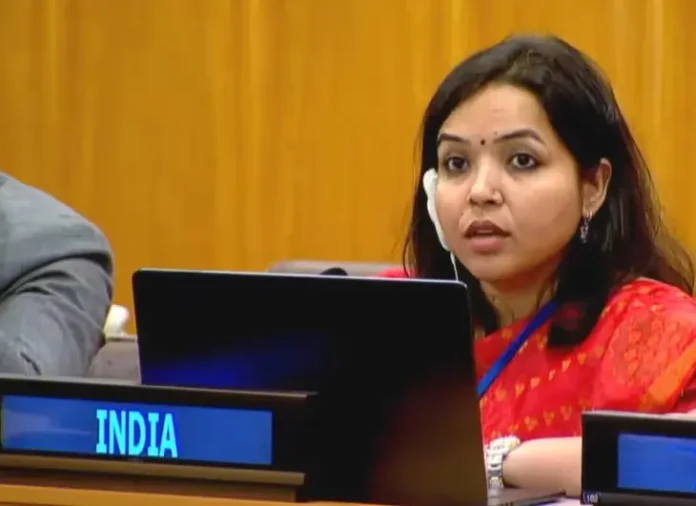
United Nations, October 21: India has opposed the use of human rights allegations as instruments of political pressure against individual countries, telling the United Nations that international scrutiny must rely on verified evidence, transparency and consistent standards rather than selective interpretations of reports.
Speaking at the UN General Assembly’s Third Committee on Tuesday, Barkha Tamrakar, Deputy Secretary in the Ministry of External Affairs’ UN Economic and Social Division, rejected attempts to portray India negatively through unverified claims, incomplete statistics or reports containing no country-specific observations.
Tamrakar said India remained willing to address specific, properly documented allegations through established institutional channels.
She maintained that engagement with international human rights mechanisms must follow principles of dialogue, consultation, cooperation, transparency and non-selectivity.

The remarks came during an interactive dialogue with Juan Pablo Alban Alencastro, Chair of the UN Committee on Enforced Disappearances, and Grazyna Baranowska, Chair-Rapporteur of the UN Working Group on Enforced or Involuntary Disappearances.
Tamrakar urged delegations to represent the findings of international reports accurately and avoid treating humanitarian communications as definitive judgments against countries.
The discussion also raised questions about how independent UN human rights experts assess allegations. Some rapporteurs appointed by the Human Rights Council rely on submissions from unidentified parties without independently corroborating the information.
Addressing India’s position on enforced disappearances, Tamrakar said New Delhi had signed the International Convention for the Protection of All Persons from Enforced Disappearance.
She cited constitutional and institutional protections available within India, including Article 21 of the Constitution, which guarantees the right to life and personal liberty.
According to Tamrakar, India’s independent judiciary can issue writs of habeas corpus, providing a legal remedy against alleged unlawful detention or disappearance.

She also identified the National Human Rights Commission and State Human Rights Commissions as institutions through which individuals can seek redressal of grievances.
The Right to Information Act, she said, strengthens transparency and accountability within the country’s governance framework.
Tamrakar further pointed to independent media organisations and civil society groups as additional safeguards for protecting individual rights and examining allegations of violations.
India’s intervention placed emphasis on evidence-based assessments while maintaining its willingness to cooperate with international human rights institutions.
The government reiterated that international engagement should distinguish between documented cases requiring examination and allegations that lack sufficient verification, particularly when assessing individual countries’ human rights records.