India took a significant step towards harnessing its maritime resources with the launch of the country’s first-ever open-sea marine fish farming project in the Andaman Sea, signalling a shift in how ocean-based livelihoods and economic potential are being approached at the national level.
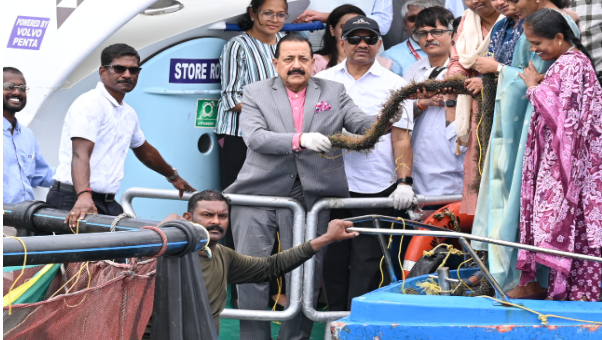
The pilot project was launched at North Bay, Sri Vijaya Puram, during a field visit by the Union Minister of State (Independent Charge) for Science and Technology and Earth Sciences. The initiative is being implemented through collaboration between the Ministry of Earth Sciences, its technical arm the National Institute of Ocean Technology, and the Union Territory Administration of Andaman and Nicobar Islands.
The project focuses on cage-based cultivation of marine finfish and deep-water seaweed in open-sea conditions, marking a departure from traditional near-shore or land-based aquaculture practices. Designed to operate in natural oceanic environments, the open-sea cages developed by NIOT are intended to withstand marine conditions while enabling scientific monitoring and sustainable production.
During the launch, two livelihood-oriented interventions were initiated for local fishing communities. Seaweed seeds were distributed to promote open-sea cultivation of marine flora, while finfish seeds were provided for cage-based farming using NIOT-developed technology. The initiative integrates scientific innovation with livelihood generation, positioning fishing communities as direct stakeholders in the emerging Blue Economy framework.
Officials associated with the project indicated that the pilot aims to assess technical feasibility, environmental sustainability and economic viability before considering wider replication. The Andaman Sea, with its relatively pristine waters and biodiversity, has been identified as a suitable location for such experimental interventions.
The initiative reflects a broader policy shift towards recognising the economic value of India’s oceans. For decades after Independence, marine resources remained largely underexplored as development priorities focused primarily on the mainland. Since 2014, however, national policy has increasingly emphasised the role of maritime and coastal regions as engines of growth, employment and innovation.
India’s oceanic domain is characterised by diverse and distinct marine environments along its western, eastern and southern seaboards, as well as its island territories. Policymakers have highlighted that these heterogeneous regions offer varied opportunities across fisheries, mariculture, biotechnology and ecosystem services, requiring location-specific approaches rather than uniform models.
While the current open-sea farming initiative is being undertaken through government-led collaboration, officials have indicated that the experience gained could enable future expansion through public-private participation. Such models are expected to accelerate deployment, scale up production and widen livelihood opportunities while maintaining scientific oversight.
As part of the visit to the islands, the Minister also visited the Mahatma Gandhi Marine National Park near Wandoor, one of India’s earliest designated marine protected areas. Established in 1983 and spread across 15 islands, the park is known for its coral reefs, mangroves and diverse marine life, including turtles and a wide range of fish species. The visit highlighted the need to balance economic use of marine resources with conservation and ecological sustainability.
The launch at North Bay underscores the Government of India’s approach of taking science and technology directly to the field, particularly in coastal and island regions. By combining advanced marine technology with local participation, the initiative seeks to lay the groundwork for an ocean-led development model in which island communities play a central role.
As India expands its Blue Economy ambitions, the open-sea fish farming pilot in the Andaman Sea is being viewed as an early indicator of how science-driven interventions could reshape livelihoods, food security and economic engagement with the country’s vast maritime domain.