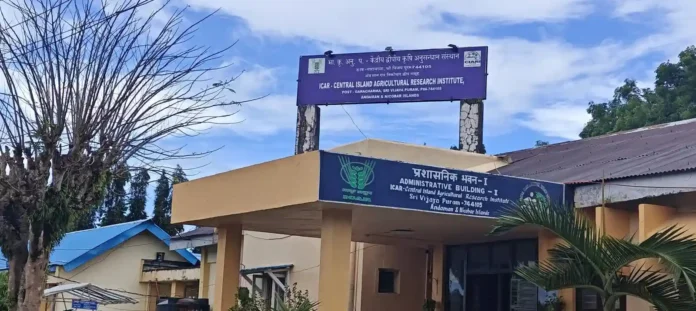
The ICAR–Central Island Agricultural Research Institute (ICAR–CIARI), Sri Vijaya Puram, has developed four technologies targeting challenges in traditional food processing, animal health and efficient use of natural resources, with the innovations now available for commercialisation.
The developments include two low-cost mechanical devices intended to simplify food-processing activities in tribal households, an acaricidal formulation to control ticks and other ectoparasites in animals, and a natural hydrogel extracted from brown seaweed to improve moisture retention.
The Dweep Nicobari Aloo Peeler is a hand-operated device designed to remove the rough and uneven skin of Nicobari aloo. Its design reduces the manual effort and processing time required for peeling while minimising food wastage.
The institute has also developed the Dweep Pandanus Fruit Pulp Extractor, a hand-operated stainless-steel device that separates edible pulp from the fibrous portions of Pandanus fruits. The equipment is intended to make traditional processing easier and reduce labour and time, particularly in tribal households.
In the animal-health sector, ICAR-CIARI has developed an acaricidal formulation and method for controlling ectoparasites, particularly ticks, in farm and pet animals. The formulation demonstrates ovicidal, larvicidal, nymphicidal and adulticidal activities, enabling it to target different developmental stages of ticks. The technology aims to help control infestations and reduce associated losses.
Another development involves the preparation of calcium alginate, also known as a phyco-colloid, from brown seaweed through a modified extraction process. The resulting natural hydrogel can retain moisture up to 1.7 times its weight and gradually release water to plants. It can also help reduce water loss and improve nutrient retention in soil and other growing media.
The four developments represent applications of research in food-processing equipment, animal parasite management and natural-resource utilisation. Their availability for commercialisation offers scope for practical application by farmers, entrepreneurs, startups, Self-Help Groups (SHGs), industries and other organisations.
Interested parties seeking information on purchasing or commercialising the technologies can contact the Director, ICAR-CIARI, Sri Vijaya Puram, through email at director.ciari@icar.org.in.The ICAR–Central Island Agricultural Research Institute (ICAR–CIARI), Sri Vijaya Puram, has developed four technologies targeting challenges in traditional food processing, animal health and efficient use of natural resources, with the innovations now available for commercialisation.
The developments include two low-cost mechanical devices intended to simplify food-processing activities in tribal households, an acaricidal formulation to control ticks and other ectoparasites in animals, and a natural hydrogel extracted from brown seaweed to improve moisture retention.
The Dweep Nicobari Aloo Peeler is a hand-operated device designed to remove the rough and uneven skin of Nicobari aloo. Its design reduces the manual effort and processing time required for peeling while minimising food wastage.
The institute has also developed the Dweep Pandanus Fruit Pulp Extractor, a hand-operated stainless-steel device that separates edible pulp from the fibrous portions of Pandanus fruits. The equipment is intended to make traditional processing easier and reduce labour and time, particularly in tribal households.
In the animal-health sector, ICAR-CIARI has developed an acaricidal formulation and method for controlling ectoparasites, particularly ticks, in farm and pet animals. The formulation demonstrates ovicidal, larvicidal, nymphicidal and adulticidal activities, enabling it to target different developmental stages of ticks. The technology aims to help control infestations and reduce associated losses.

Another development involves the preparation of calcium alginate, also known as a phyco-colloid, from brown seaweed through a modified extraction process. The resulting natural hydrogel can retain moisture up to 1.7 times its weight and gradually release water to plants. It can also help reduce water loss and improve nutrient retention in soil and other growing media.
The four developments represent applications of research in food-processing equipment, animal parasite management and natural-resource utilisation. Their availability for commercialisation offers scope for practical application by farmers, entrepreneurs, startups, Self-Help Groups (SHGs), industries and other organisations.
Interested parties seeking information on purchasing or commercialising the technologies can contact the Director, ICAR-CIARI, Sri Vijaya Puram, through email at director.ciari@icar.org.in.