New Delhi, May 1: India has advanced its Great Nicobar development plan, positioning the island as a future strategic maritime and economic hub with major infrastructure projects aimed at strengthening trade connectivity, defence presence, and regional integration in the Indian Ocean region.
An official statement issued on Friday confirmed that the project is designed to leverage the island’s proximity to the global East–West international shipping route, reducing India’s dependence on foreign transshipment hubs while enhancing national security and maritime influence.
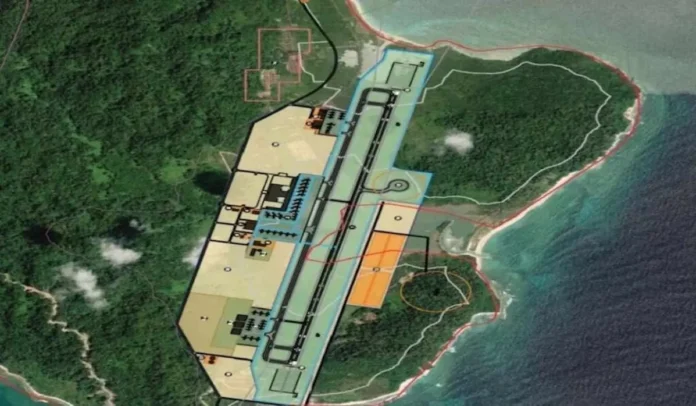
The proposed development at Great Nicobar includes a 14.2 million twenty-foot equivalent unit (MTEU) International Container Transshipment Terminal at Galathea Bay, a Greenfield international airport, a 450 MVA gas–solar hybrid power plant, and a planned township to support long-term habitation and economic activity.

Officials noted that India currently lacks deep-water berths capable of handling large cargo vessels, forcing a significant share of transshipment cargo to pass through ports such as Colombo, Singapore and Klang. This dependence, according to the statement, results in substantial revenue loss and limits India’s direct participation in global shipping flows.
The Galathea Bay port is being developed under the Holistic Development of Great Nicobar Island as part of the Island Development Programme. Its location, approximately 40 nautical miles from a major international shipping corridor and with natural depths exceeding 20 metres, is seen as a key logistical advantage for attracting both gateway and transshipment cargo.
The statement added that several neighbouring countries, including Myanmar, China and Sri Lanka, are expanding deep-water port infrastructure to capture growing maritime trade flows in the region, increasing the strategic urgency of India’s own development initiative.
Alongside the port, the planned international airport is intended to significantly improve regional connectivity and support tourism and logistics expansion. Officials highlighted that Port Blair airport currently handles around 1.8 million passengers annually, while the new facility is expected to handle at least 1 million passengers at launch and scale up to nearly 10 million passengers per year over time.
The township component of the project is designed to accommodate residential, institutional and commercial requirements linked to the port-led economic ecosystem. It will provide infrastructure support for workers, service providers and associated industries expected to emerge from the development.
Authorities also underlined environmental considerations, stating that 1.82 per cent of the island’s forest cover will be diverted for development, with compensatory afforestation planned over 97.3 square kilometres. The project framework is positioned within a regulated environmental compliance structure.

The island’s ecological profile and biodiversity are being highlighted alongside its tourism potential, with references to its proximity to international destinations such as Phuket, Langkawi and Senang City.
According to the statement, tribal welfare remains a central component of the project, with no displacement proposed for the Shompen and Nicobarese communities. It also notes a planned increase in notified tribal reserve areas through re-notification measures.
The Great Nicobar Project continues to move forward as a large-scale infrastructure initiative balancing strategic maritime interests, economic development, environmental safeguards and indigenous community protection within India’s long-term regional planning framework.