In a step aimed at strengthening freshwater aquaculture in the Andaman and Nicobar Islands, the Department of Fisheries has undertaken a major fish seed production and distribution exercise at its Fish Seed Farm in Nayagaon. The initiative focuses on ensuring sustainable fish production, reducing dependence on external sources for seed supply, and enhancing the livelihood security of island farmers who rely on aquaculture as a significant source of income.
According to details shared, the Fisheries Department has produced seeds of Indian Major Carps at its Nayagaon facility and carried out the large-scale stocking of fingerlings and fry in multiple locations. A total of 1,250 fingerling-sized fish seeds were airlifted using helicopter services and released into the Amrit Sarovar ponds of Nicobar District. Similarly, 900 fry-sized fish seeds were stocked in the Amrit Sarovar ponds of South Andaman District. This logistical step was crucial in overcoming geographical barriers that often limit the distribution of live fish seeds to far-flung islands within the archipelago.
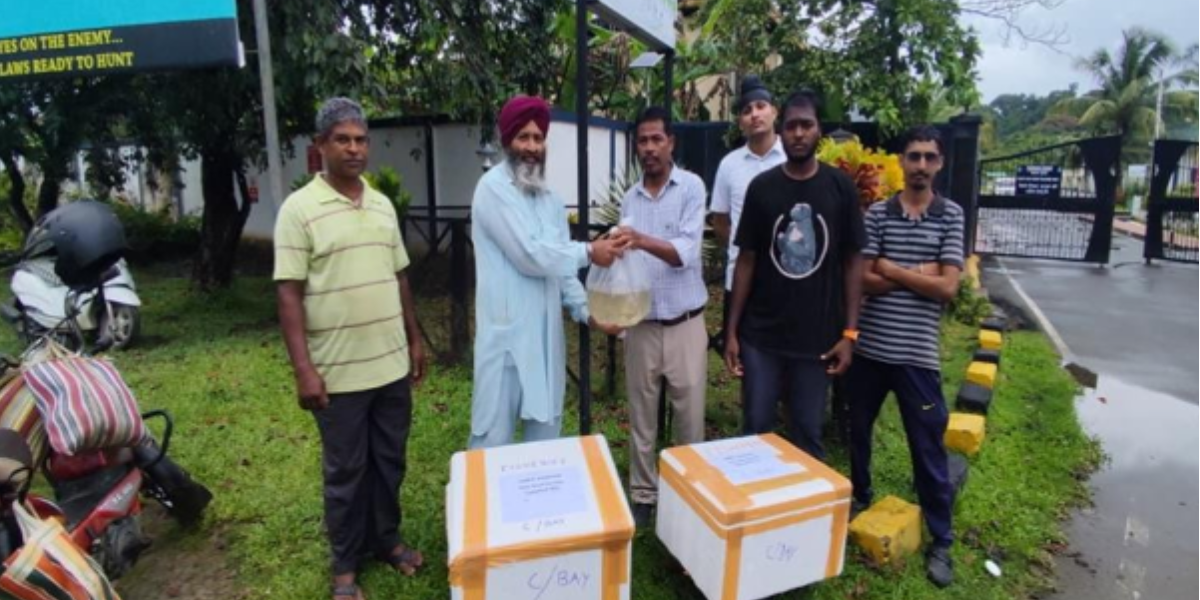
Alongside stocking in government-identified ponds, the department has also distributed fish seeds among local pisciculturists. The approach is designed not only to improve fish availability for consumption but also to encourage entrepreneurship in aquaculture, thereby contributing to food security and economic stability across the islands. By making quality fish seed available locally, the administration aims to reduce the dependency of farmers on supplies from mainland India, where delays and high transport costs often affect productivity.
The initiative is part of a broader commitment by the A&N Administration towards sustainable fisheries development and promoting self-reliance in fish seed production. For island communities, where fishing and aquaculture remain primary livelihoods, such measures are seen as critical for long-term resilience. The availability of carp seeds also adds diversity to inland aquaculture practices, traditionally dominated by smaller native species, and helps improve overall yields.

Experts highlight that stocking fingerlings in water bodies not only ensures better survival rates compared to fry but also accelerates the growth cycle, enabling farmers to harvest marketable fish more quickly. By distributing seeds across different districts, the department also ensures that aquaculture development is evenly spread, rather than concentrated in specific pockets.
The inclusion of Amrit Sarovar ponds in this programme connects fisheries development to the government’s broader mission of rejuvenating water bodies. These ponds, developed as part of the nationwide Amrit Sarovar initiative, are being repurposed to serve as productive sites for fish farming, thus integrating water conservation with livelihood promotion.
Fish farmers across the islands are expected to benefit from the distribution, as quality seed availability has often been a bottleneck in scaling up aquaculture operations. Beyond direct production, the initiative also aims to build confidence among new entrants to pisciculture by providing them with reliable inputs. The administration’s emphasis on local seed production is viewed as a step towards reducing environmental stress from long-distance seed transportation and aligning fisheries practices with sustainable models.
The Fisheries Department has reiterated its focus on expanding aquaculture infrastructure, including seed farms, hatcheries, and cold chain facilities, to support the growing demand. Officials underline that aquaculture, if scaled scientifically, can emerge as a strong pillar of the island economy, complementing marine fisheries that often face seasonal uncertainties.
As the seeds begin to grow in Nicobar and South Andaman ponds, the long-term outcome of this initiative will be observed in the form of improved fish harvests, enhanced farmer incomes, and strengthened food security. For an island territory heavily dependent on imports for many essentials, bolstering local aquaculture is expected to significantly reduce the gap between demand and supply.
By linking seed production, distribution, and farmer participation, the Andaman and Nicobar Administration is working towards a cycle of self-reliance that could serve as a model for other island territories in India.