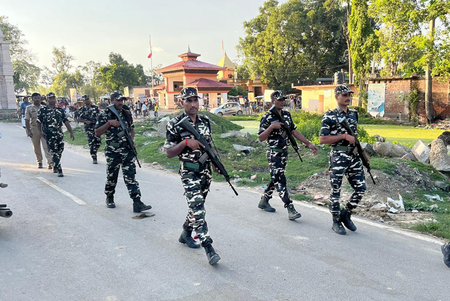
Security and intelligence agencies have stepped up surveillance along the India-Nepal border amid a nationwide hunt for suspects involved in the recent Delhi blasts. Officials fear the accused may attempt to flee India through the porous border, a route once frequently used by Indian Mujahideen operatives.
According to intelligence inputs, the suspects could be planning to exit India through Nepal and then enter Pakistan. Security officials said that while the number of individuals involved in the blasts remains unclear, those arrested during the Faridabad module bust are being interrogated for leads. Though no major revelations have emerged yet, agencies remain confident that the ongoing probe will yield critical information.
Authorities have instructed residents along the border areas to report any suspicious movement immediately. “The accused will do everything possible to escape India. We have intensified border checks, and every movement is under close scrutiny,” an official said.
Meanwhile, fresh raids have been launched in Shopian, Jammu and Kashmir, targeting overground workers suspected of aiding terror networks. Investigators have linked the Faridabad module, allegedly operated by the Jaish-e-Mohammad (JeM), to the Delhi blast. The probe has revealed that the module received significant logistical support from Jammu and Kashmir.

Officials identified Maulvi Irfan Ahmed as a key recruiter and radicalisation agent behind the module. Intelligence reports suggest that Ahmed was instrumental in enlisting members and facilitating communication between handlers. “The Delhi blast is directly connected to the Faridabad module,” a senior intelligence officer confirmed.
The development points to a shift in terrorist activity, with the JeM redirecting its focus from Jammu and Kashmir to the Indian heartland due to heightened security in the Valley following the Pahalgam attack. The crackdown in Jammu and Kashmir has also extended to members of the Jamaat-e-Islami, who are suspected of supporting cross-border terror activities.
Sources said Ahmed has been cooperating with investigators and providing details about handlers and associates. The Jamaat’s activities have come under renewed scrutiny, particularly after the group reportedly strengthened ties with Pakistan’s Inter-Services Intelligence (ISI) following political changes in Bangladesh.
Multiple security and intelligence agencies are coordinating on the investigation, which now extends beyond the Delhi blast to uncover a wider terror network. The magnitude of explosives recovered from the module suggests plans for multiple coordinated attacks across India.
Meanwhile, forensic experts from the Forensic Science Laboratory (FSL) revisited the blast site to collect additional evidence. The team recovered two cartridges, including one live round, and gathered samples of two different explosive materials. In total, 40 samples are being analyzed to determine the precise nature and composition of the explosives used.
Officials emphasized that the widening scope of the investigation reflects the seriousness of the threat, with agencies racing to dismantle the broader module behind the Delhi blasts before further incidents occur.