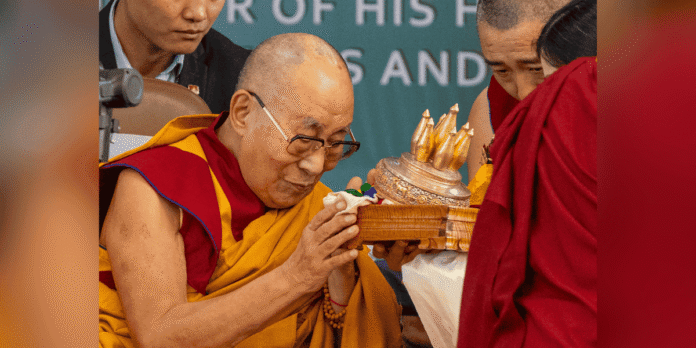
The Dalai Lama, the globally respected Tibetan spiritual leader, has won his first Grammy Award at the age of 90, receiving recognition in the Best Audio Book, Narration and Storytelling Recording category for his work “Meditations: The Reflections Of His Holiness The Dalai Lama.” The award places his spiritual teachings alongside contemporary storytelling voices on one of the world’s most visible cultural platforms.
The project blends his spoken reflections with innovative collaborations incorporating Hindustani classical musical influences. The recordings feature collages of his remarks on mindfulness, harmony, health, compassion and environmental responsibility, drawn from talks delivered over recent years. Musician Rufus Wainwright accepted the award on his behalf during the ceremony streamed online.

Responding to the recognition, the Dalai Lama said he accepted it with gratitude and humility, describing it not as a personal achievement but as acknowledgement of shared universal responsibility. He emphasised that peace, compassion, care for the environment and understanding the oneness of humanity are essential for the well-being of all people. He added that the recognition would help spread these messages more widely.
The award adds a cultural milestone to the Dalai Lama’s long public life shaped by exile and advocacy. Born Tenzin Gyatso, he became the 14th Dalai Lama and Tibet’s spiritual leader at a young age. After China’s takeover of Tibet in 1950 and the suppression of a Tibetan uprising, he fled in 1959, undertaking a difficult journey into India. He initially stayed in Mussoorie before settling in Dharamsala, which became the centre of the Tibetan government-in-exile.

For more than six decades, he has travelled globally promoting human values, interfaith harmony and preservation of Tibetan culture and language, drawing intellectual inspiration from India’s Nalanda tradition. His life story includes early encounters with Chinese leadership, exile at 25, and decades of efforts to highlight Tibet’s unresolved political and cultural questions.
India today hosts around one lakh Tibetans, and Dharamsala remains the focal point of Tibetan cultural and political life in exile. In his recent book, he reflects on decades of engagement with China and the broader struggle faced by Tibetans. The Grammy recognition highlights how spiritual and philosophical narratives are increasingly reaching audiences through contemporary creative formats, extending his influence beyond traditional religious or political platforms into global cultural conversations.