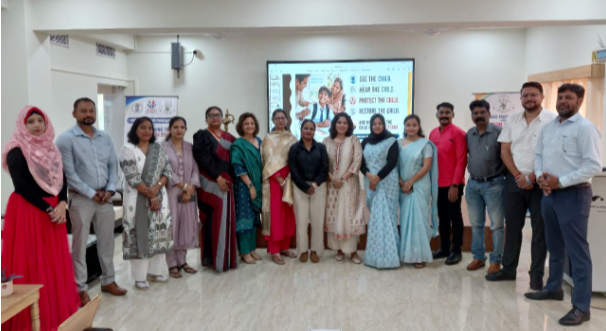
Sri Vijaya Puram, Aug. 26: The State Child Protection Society (SCPS), Directorate of Social Welfare, organised a one-day training programme aimed at strengthening the child protection system for missing children, children in need of care and protection (CNCP), and children in conflict with law (CCL).
The training programme was held on August 24 and brought together 57 participants, including officials and stakeholders associated with the child protection system in the Andaman & Nicobar Islands.
The programme was attended by Jayanta Mukherjee, Principal Magistrate, Juvenile Justice Board, South Andaman, as the chief guest, along with Mohit Mishra, Director, Social Welfare, and other officials and stakeholders.
The training focused on strengthening the knowledge and capacity of agencies involved in the identification, care, protection, rehabilitation, restoration and social reintegration of children requiring institutional or statutory intervention.
Participants were also provided an opportunity to examine the importance of coordination among different agencies involved in child protection. The programme covered the roles and responsibilities of key institutions, including the Child Welfare Committee (CWC), Juvenile Justice Board (JJB), District Child Protection Unit (DCPU), Child Care Institutions (CCIs), Observation Home, Police Department, NGOs and Legal Services Authorities.
The focus on coordination is particularly significant in cases involving missing children and children requiring care and protection, where timely intervention can influence the effectiveness of rescue, rehabilitation and restoration measures.
The sessions also addressed children in conflict with law, with discussions covering identification, case management, care, protection, rehabilitation and restoration.
Inspector Jyoti Chhatwal, In-Charge of the CAW Cell, SHO and AHT, South Andaman District, spoke on “Missing Children & CCL: Identification, Case Management, Care, Protection, Rehabilitation and Restoration.” Her session focused on the processes and responsibilities involved in dealing with children who are missing or in conflict with law.
Rubina Khatib Siddiqui, former Member of the National Commission for Protection of Child Rights (NCPCR), addressed participants on “Child Rights and Child Protection: Role of Stakeholders in Ensuring the Rights of Children.”
The programme provided a platform for stakeholders to discuss existing child protection practices and challenges while underlining the need for effective coordination and timely intervention.
The training also emphasised that child protection is not the responsibility of a single department but requires coordinated action involving government agencies, law enforcement, statutory bodies, institutions, civil society organisations and the wider community.
At the conclusion of the programme, participation certificates were distributed to all participants.
The SCPS has also urged members of the public to remain vigilant and promptly inform the concerned authorities in cases involving missing children, child abuse, neglect, exploitation or any child in need of care and protection.
The programme comes against the backdrop of the need for an integrated child protection mechanism in which different agencies are able to respond efficiently to vulnerable children. Strengthening the capacity of frontline personnel and stakeholders can help improve identification, intervention and rehabilitation processes.
By bringing together representatives and personnel connected with the child protection system, the training sought to improve understanding of statutory responsibilities while reinforcing the importance of placing the safety, dignity and welfare of children at the centre of interventions.
The SCPS said the programme was intended to strengthen the overall child protection framework through greater awareness, improved coordination and enhanced capacity among stakeholders working with vulnerable children in the Islands.