
Sri Vijaya Puram, May 18: A sharp fall in the CBSE Class XII pass percentage in the Andaman and Nicobar Islands has triggered concern among parents, students and educators, with questions being raised over stricter evaluation practices and reduced moderation in marking.
The islands recorded a pass percentage of 81.08 percent in 2026, down sharply from 92.54 percent in 2025 and 94.48 percent in 2024.
Teachers said the decline has brought renewed attention to the Objective Evaluation Methodology, or OEM, a more standardised assessment process that requires examiners to follow fixed marking schemes and predefined answer points.

According to educators, the system leaves less room for flexible marking and places greater emphasis on precise, keyword-based answers. This may have affected students in descriptive subjects, where broader explanatory writing has traditionally helped candidates score better.
The dip has also revived concerns over academic preparedness in remote island regions, where students often have limited access to coaching support, model-answer training and digital learning resources compared to mainland centres.
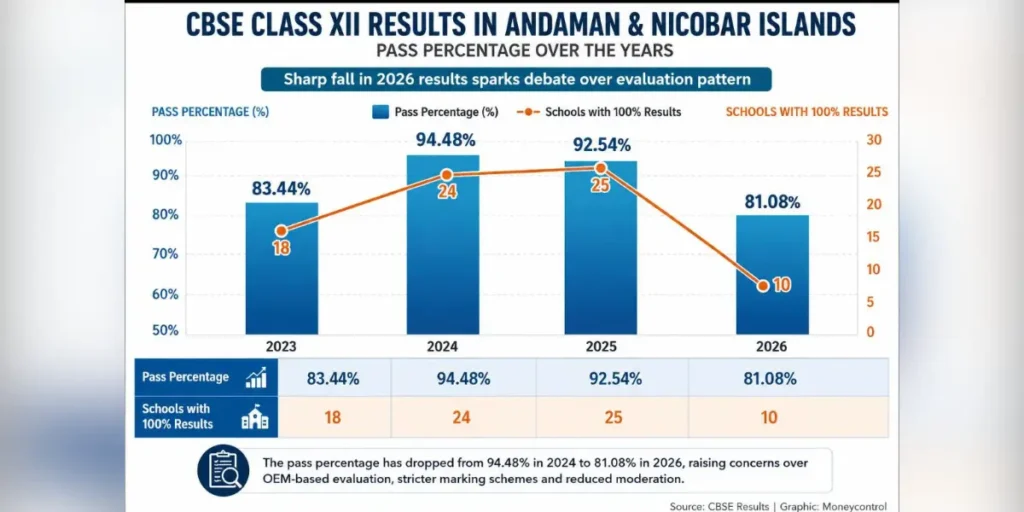
Despite the overall decline, 10 schools in the islands recorded 100 percent results this year. These include Kendriya Vidyalaya No. 1, Jawahar Navodaya Vidyalaya Chouldari, Government Senior Secondary School Bengali, Government Senior Secondary School Long Island, Government Senior Secondary School Tushnabad, Vivekananda Kendra Vidyalaya Lamba Line, Crescent Public School, Navy Children School Minnie Bay, Saraswati Shishu Mandir School and St Xavier School Mannarghat.
The fall becomes starker when compared with previous years. In 2025, the islands recorded a pass percentage of 92.54 percent, with 25 schools securing 100 percent results. In 2024, the pass percentage stood at 94.48 percent, while 24 schools achieved complete pass records. In 2023, the overall pass percentage was 83.44 percent, with 18 schools recording 100 percent results.

Education observers said the fact that several schools continued to report cent percent results even in a weaker year points to uneven academic outcomes across the islands. Schools with stronger teaching systems, better preparation structures and more experienced faculty appeared to perform more consistently despite the stricter evaluation environment.
While CBSE has not officially linked the decline to OEM-based assessment practices, discussions around tighter marking schemes, reduced moderation and standardised answer evaluation have dominated post-result conversations across the islands this year.