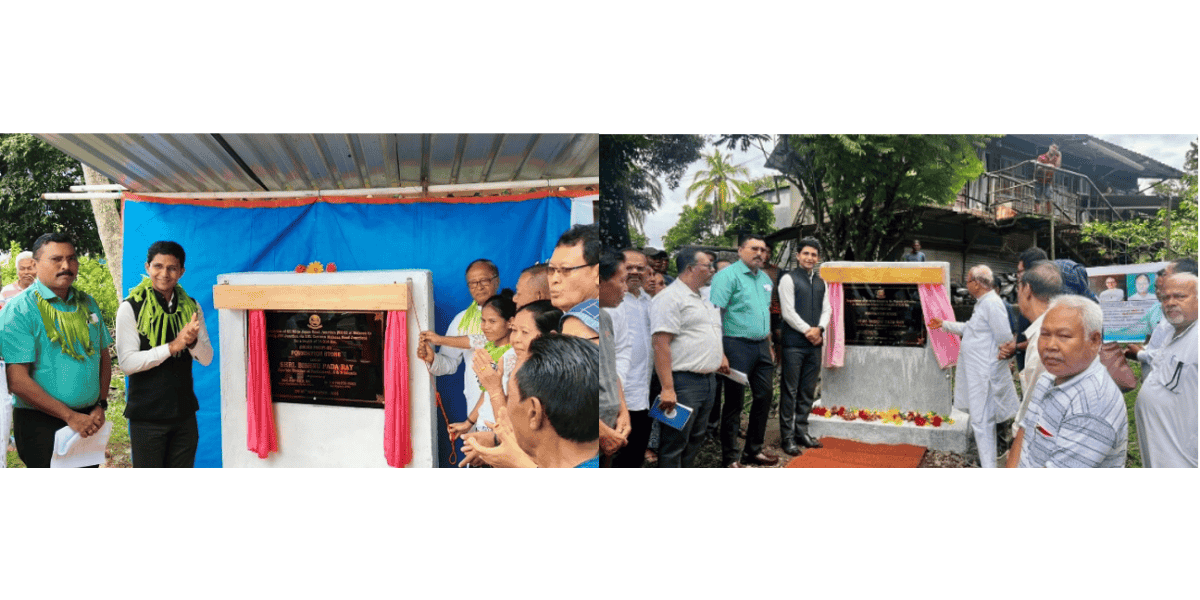
Car Nicobar marked a significant milestone in its developmental journey as foundation stones were laid for three major road upgradation projects under the Pradhan Mantri Gram Sadak Yojana Phase III (PMGSY-III) on September 30. The initiative aims to provide safer and more reliable transport networks in the island’s rural areas, addressing long-standing challenges of connectivity faced by the tribal population.
The projects include the upgradation of the road from SH-03 to Kinmai, covering 2.25 kilometres with an estimated cost of Rs 2.63 crore; the SH-03 to Malacca stretch via Japan Road Junction to JNV Junction Arong, spanning 14.01 kilometres at Rs 16.02 crore; and the Kakana Junction to APWD Guest House Junction, SBI to SH-03, stretching 7.14 kilometres with a budget of Rs 8.27 crore. Together, these works represent an investment exceeding Rs 26 crore in strengthening rural infrastructure in Car Nicobar.

The foundation stone-laying ceremony was attended by elected representatives, senior government officials, and members of the local tribal council. Community leaders and residents also participated, reflecting the widespread interest in the projects. The presence of the Chief Tribal Captain and other respected elders underscored the cultural significance of the occasion, as roads in Car Nicobar are not only about mobility but also about linking communities across diverse villages.
According to officials from the Andaman Public Works Department (APWD), the projects will adhere to national design standards to ensure durability and resilience against the island’s harsh climatic conditions. Technical plans include measures to address drainage, surface stability, and long-term maintenance, given the region’s vulnerability to heavy rains and coastal weathering. The APWD has committed to completing the works within the stipulated timelines and emphasized that quality will be closely monitored.
Improved connectivity has far-reaching implications for Car Nicobar’s residents. Safer and faster roads mean better access to essential services such as schools, hospitals, and markets. For students, travel to educational institutions will become less arduous, while patients requiring timely medical care will benefit from smoother transport to healthcare facilities. Farmers and traders stand to gain from more efficient movement of agricultural produce and goods, potentially expanding local economic opportunities.
For an island that has often been at the receiving end of nature’s fury, road projects of this scale also carry strategic importance. In times of emergency, reliable road infrastructure can support faster evacuation and disaster response. Authorities have highlighted that strengthening rural roads is central to building resilience and preparedness for such situations.
The launch of the projects is also symbolic of the government’s efforts to prioritize remote and marginalized communities. Car Nicobar, with its predominantly tribal population, has long demanded better connectivity. While air and sea routes link the island to the rest of the archipelago, internal mobility depends almost entirely on road networks. By upgrading key stretches, the projects aim to integrate far-flung villages more closely into the mainstream of development.

Community members present at the ceremony welcomed the initiative, noting that the upgraded roads will directly impact their daily lives. The inclusion of stretches connecting residential clusters to public institutions reflects an attempt to match infrastructure priorities with social needs. Local leaders emphasized the importance of community cooperation to ensure that the projects are executed smoothly and free from delays.
The PMGSY programme, launched in 2000, was designed to provide all-weather road connectivity to unconnected habitations. Its third phase focuses on consolidating and upgrading existing rural road networks to enhance transport efficiency and promote rural economic growth. The works at Car Nicobar are part of this nationwide framework, adapted to the unique geographical challenges of the islands.
As foundation stones give way to construction activity, Car Nicobar looks forward to a tangible transformation in its mobility landscape. The projects will not only enhance the efficiency of everyday transport but also symbolize inclusion, resilience, and progress for a community that has often faced the dual burdens of remoteness and vulnerability.
With work expected to commence shortly, the coming months will be closely watched by residents, stakeholders, and administrators alike. For the islanders, these roads promise not just improved connectivity but also the assurance of being better integrated into the region’s broader development story.