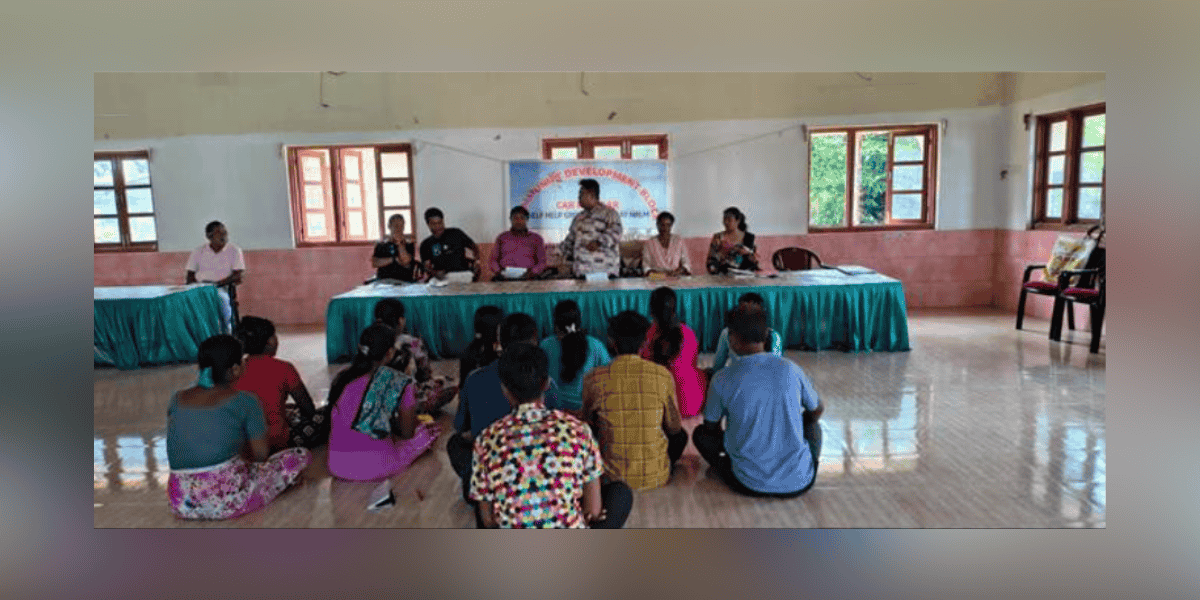
A village-to-village outreach under the Deen Dayal Upadhyay Grameen Kaushalya Yojna (DDU-GKY), a Government of India initiative for rural youth skill development and employment generation, was held at Kakana Community Hall, Car Nicobar, focusing on collective farming, mechanized copra processing, and rural livelihoods.
Organized by the CD Block, Car Nicobar in collaboration with the Department of Agriculture, the programme aimed to sensitize local farmers about the formation of Farmer Producers Organizations (FPOs), market linkages, and sustainable agriculture practices. Officials highlighted opportunities for skill development, entrepreneurship, and value addition in coconut-based products.
Extension Officer (i/c), CD Block, Car Nicobar, briefed participants on the Rozgar & Ajeevika Mission under the Viksit Bharat–Guarantee for Rozgar and Ajeevika (VB-G RAM G) Act, specifically focusing on coconut drying, and introduced the free residential skill training available under DDU-GKY 2.0.

The Agriculture Officer, Car Nicobar, emphasized the importance of mechanized copra processing to reduce moisture content and improve quality, noting that the Multi-Purpose Farm in Perka has a mechanized Copra Drying and Vacuum Packaging unit. “This unit enhances copra quality and market value, enabling farmers to secure better prices,” the officer said, urging community groups and Self-Help Groups (SHGs) to take responsibility as operating entities for the unit.
Participants were also encouraged to explore further opportunities in coconut-based value addition, including coconut oil extraction using cold and hot press methods, and the development of handicrafts and products such as coconut shell crafts, coir mats, ropes, charcoal, and confectionery items. Officials highlighted that these initiatives not only improve income security but also foster empowerment among smallholder farmers and youth.
The session featured addresses from the Extension Officer (i/c), Cluster Coordinator, Village Level Worker (VLW), Community Resource Persons (CRPs), and Data Entry Operators of DDU-GKY, who collectively motivated the attendees to participate actively in skill development programmes and adopt mechanized processing methods.
The event saw active engagement from village headmen, farmers, and youth, reflecting the community’s interest in adopting modern agricultural practices while enhancing rural livelihoods. Officials stressed that integrating technology and training with traditional farming practices would boost productivity, improve quality, and create sustainable employment for the rural workforce.
The DDU-GKY village-to-village initiative, part of a nationwide effort to link skill training with employment opportunities, is expected to transform rural livelihoods in Car Nicobar by combining traditional farming, modern mechanization, and market-oriented strategies.
By facilitating skill development, improving agricultural practices, and promoting value-added products, the programme aligns with broader government objectives of rural empowerment and sustainable economic growth.