The Special Intensive Revision (SIR) of Electoral Rolls with reference to January 1, 2026, has reached a key milestone in the Andaman and Nicobar Islands, with enumeration forms collected from more than 79 per cent of electors during the first phase, according to data released by the Election Commission of India (ECI). The draft electoral roll was formally published on December 23, marking the beginning of the claims and objections phase that will continue until January 22, 2026.
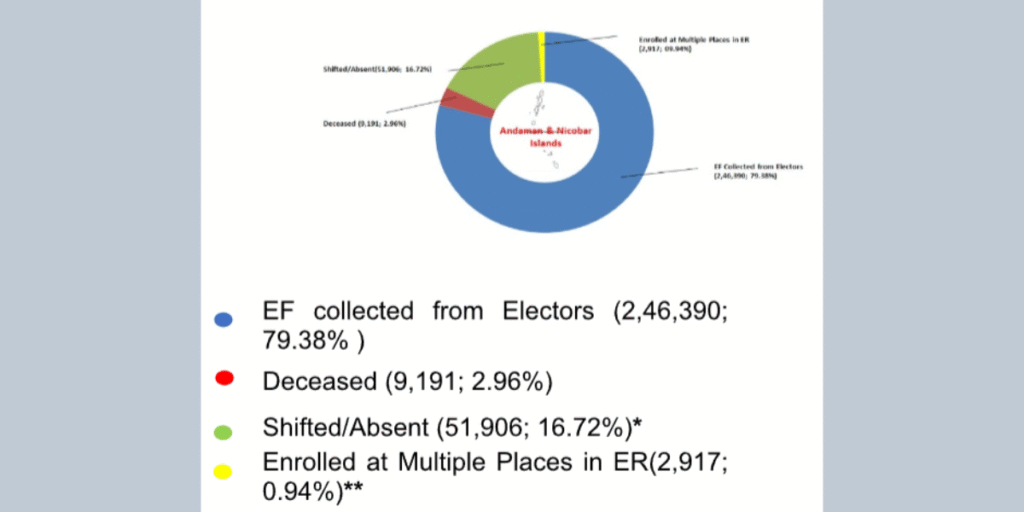
Out of a total electorate of 3,10,404 as recorded on October 27, 2025, enumeration forms were collected from 2,46,390 electors, accounting for 79.38 per cent participation. The remaining electors fall under categories including deceased, shifted or absent voters, and those found enrolled at multiple places.
According to official figures, 9,191 electors (2.96 per cent) were identified as deceased, while 51,906 electors (16.72 per cent) were categorised as shifted or absent. Additionally, 2,917 electors (0.94 per cent) were found to be enrolled at multiple locations in the electoral rolls. The Commission clarified that in cases of multiple enrolment, the elector’s name will be retained at only one location, in line with statutory provisions.
The Election Commission has emphasised that the SIR exercise is being conducted with clearly defined objectives: maximum participation of electors, complete inclusion of all eligible voters, and full transparency at every stage of the revision process.
Officials explained that enumeration forms could not be collected from certain electors primarily because they had migrated to other States or Union Territories, could not be traced at their listed addresses, failed to submit forms by the December 18, 2025 deadline, or were unwilling to register for various personal reasons. Importantly, the Commission clarified that genuine electors whose names do not appear in the draft roll can still be added during the claims and objections period by submitting the appropriate forms.
The Commission attributed the high level of participation to coordinated efforts across districts and active engagement by political parties. The exercise involved three District Election Officers (DEOs), one Electoral Registration Officer (ERO), 12 Assistant Electoral Registration Officers (AEROs), and Booth Level Officers (BLOs) deployed across 411 polling booths.

Political participation also saw a notable increase. A total of 678 Booth Level Agents (BLAs) were appointed by four major recognised political parties during the SIR, a significant rise from 435 BLAs at the start of the revision. District presidents and field representatives of political parties actively monitored the process, a factor officials said contributed to transparency and confidence-building.
To ensure that no eligible elector was left out, the Chief Electoral Officer (CEO), DEOs, ERO, and AEROs conducted extensive awareness campaigns throughout the enumeration period. Regular meetings were held with political parties to explain procedures and share progress updates.
BLOs visited the homes of all electors listed in the rolls as of October 27, 2025, distributing enumeration forms and making at least three follow-up visits where required. BLAs were permitted to submit up to 50 enumeration forms per day, enabling greater involvement of political party representatives in voter inclusion.
Several special measures were implemented to address geographical challenges and logistical constraints unique to the islands. Special enumeration camps were organised at all polling booths, while help desks were set up at the offices of the CEO, DEOs, AEROs, and at polling stations to assist electors in filling out forms.
To support field staff, 189 volunteers and 132 additional personnel were deployed. Local Anganwadi and ASHA workers were engaged to assist BLOs, particularly in reaching senior citizens and vulnerable groups. In recognition of early completion and effective performance, 48 BLOs were felicitated at district and tehsil levels.
Capacity-building measures included repeat training sessions, doubt-clearing meetings, and video tutorials to ensure accurate mapping and digitisation. For areas with poor network connectivity, common locations with internet access were arranged. In remote islands, special boats were provided to transport BLOs to digitisation centres, ensuring timely submission of data.
The SIR process also prioritised the inclusion of young electors. Individuals who have attained or will attain the age of 18 on or before January 1, 2026, are being encouraged to apply through Form-6 along with the prescribed declaration. Officials said special campaigns will be conducted across the islands to ensure maximum enrolment of first-time voters.
To strengthen verification and public trust, booth-wise lists of electors reported as deceased, permanently migrated, or whose forms were not received were shared with BLAs for cross-verification. These lists will also be displayed at Panchayat Bhavans, urban local body offices, and block offices, enabling public scrutiny.

Digital and printed copies of the draft electoral roll have been made available to all recognised political parties and published on the Chief Electoral Officer’s website. Lists of absent, shifted, deceased, and duplicate electors, along with probable reasons for non-inclusion, will also be accessible online in an easy-to-read format.
The claims and objections period will remain open from December 23, 2025, to January 22, 2026. During this time, any elector or political party may seek inclusion of eligible voters or deletion of ineligible names. One ERO and 16 AEROs have been appointed to scrutinise claims.
The Commission reiterated that no name can be deleted from the draft roll without due process. As per SIR guidelines, deletion requires prior notice and a speaking order by the ERO or AERO. Aggrieved electors may appeal to the District Magistrate and subsequently to the Chief Electoral Officer under Section 24 of the Representation of the People Act, 1950. Volunteers are being trained to assist electors in filing appeals.
Following verification and hearings during the notice phase, which will run until February 14, 2026, the final electoral roll will be published on February 21, 2026.
Chief Electoral Officer of the Andaman and Nicobar Islands, L. Kumar, IAS, formally handed over the draft electoral rolls to representatives of recognised political parties at a meeting held at the A&N Secretariat. A press briefing was also conducted to explain the SIR process, statistics, and timelines to the media.
The Commission reaffirmed its commitment to a transparent, participative, and inclusive revision exercise, stating that the objective remains to ensure that no eligible elector is excluded and no ineligible name remains in the electoral rolls.