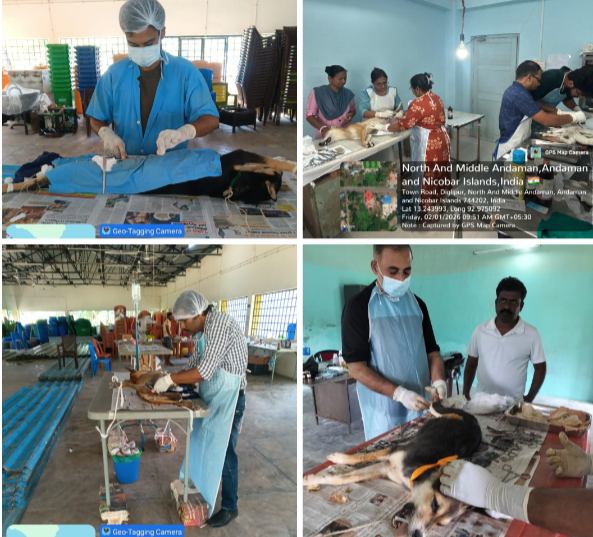
The Department of Animal Husbandry and Veterinary Services has completed a three-phase Animal Birth Control campaign across the Andaman and Nicobar Islands, marking a coordinated effort to manage the stray dog population through humane and scientific methods. The campaign was conducted between December 2025 and January 2026 in accordance with the Animal Birth Control Rules, 2023, and focused on sterilisation, post-operative care and safe release of animals.
The first phase of the operation was carried out from December 6 to 19, during which veterinary teams concentrated on Shaheed Dweep and Swaraj Dweep. These locations were prioritised due to their high tourist footfall and dense residential settlements. During this phase, a total of 212 stray dogs were sterilised at the veterinary dispensaries functioning on the two islands.
Following the initial phase, the campaign expanded to other regions during the second phase, which took place from December 26 to 30. Veterinary teams operated at major veterinary hospitals in Hut Bay, Rangat and Diglipur, covering areas in North and Middle Andaman as well as Little Andaman. Despite the limited time frame, the teams sterilised 275 stray dogs across these three locations, significantly increasing the overall coverage of the campaign.
The third and final phase was conducted from January 6 to 13, returning to Swaraj Dweep for a focused follow-up operation. During this phase, 81 additional dogs were sterilised, reinforcing the impact of the earlier intervention. With this, the total number of dogs sterilised at Swaraj Dweep across the first and third phases reached 202, ensuring sustained coverage in one of the most frequented tourist destinations in the islands.
Overall, the three-phase campaign resulted in the sterilisation of 568 stray dogs within a span of just over one month. The department stated that all procedures were carried out with due attention to animal welfare norms, including post-operative care, monitoring during recovery and vaccination against rabies wherever required. After recovery, the dogs were safely released back into their original territories, as mandated under the applicable rules.
Alongside the sterilisation drive, the department conducted community awareness activities across schools, gram panchayats and public spaces. These outreach efforts focused on educating residents about dog bite prevention, basic first-aid measures, responsible feeding practices and the importance of supporting sterilisation programmes. The awareness component was aimed at fostering coexistence between residents and stray animals while reducing conflict and health risks.
The campaign was executed under challenging island conditions, requiring coordination among veterinary surgeons, para-veterinarians, support staff and local representatives. The department highlighted that sustained teamwork and logistical planning were key to completing the operation within the stipulated period.
The Animal Husbandry and Veterinary Services department reiterated that regular and intensive Animal Birth Control operations, combined with sustained public awareness, remain the most effective strategy for long-term stray dog population management. Such efforts are also critical in preventing dog-bite incidents and maintaining public health standards.
The department reaffirmed its commitment to continuing similar campaigns in the future as part of an ongoing strategy to ensure a safer and healthier environment for residents and visitors across the Andaman and Nicobar Islands.