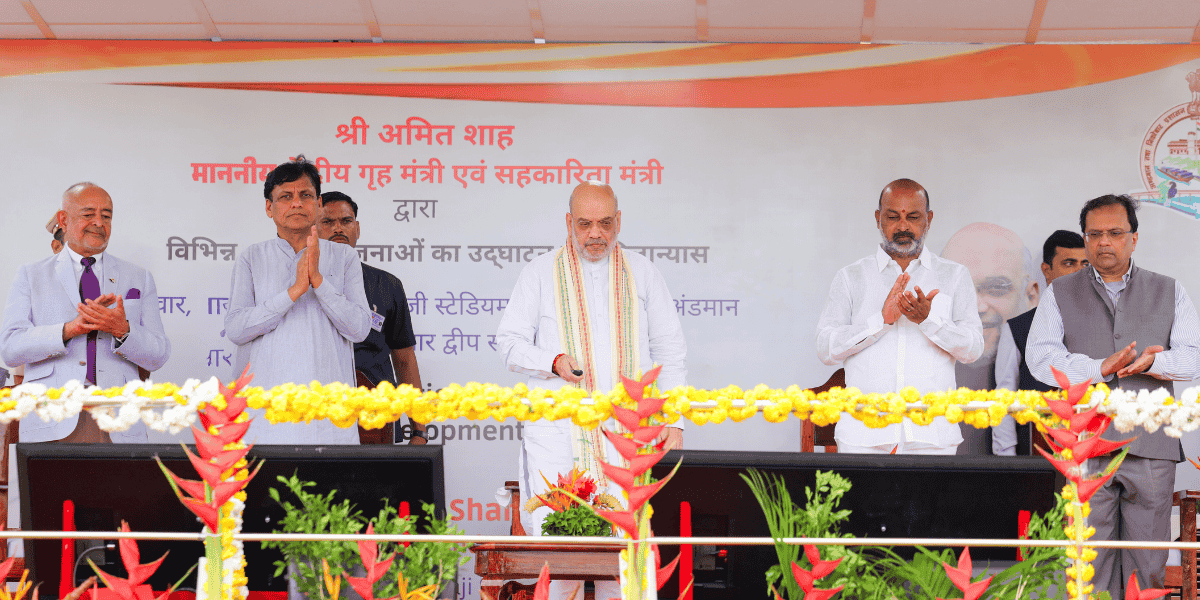
Union Home Minister and Minister of Cooperation Amit Shah on January 3 inaugurated nine development projects and laid foundation stones for two more in the Andaman and Nicobar Islands, with a total outlay of around ₹373 crore, underscoring the Centre’s focus on security, infrastructure, healthcare and justice reforms in the strategically located Union Territory.
Addressing a large public gathering at Netaji Stadium in Sri Vijaya Puram, Shah said the islands, once viewed as distant and peripheral, are now being placed at the centre of India’s development and strategic vision. He described the Andaman and Nicobar Islands as a living symbol of the country’s freedom struggle and a vital pillar of India’s future growth, maritime strength and national security architecture.
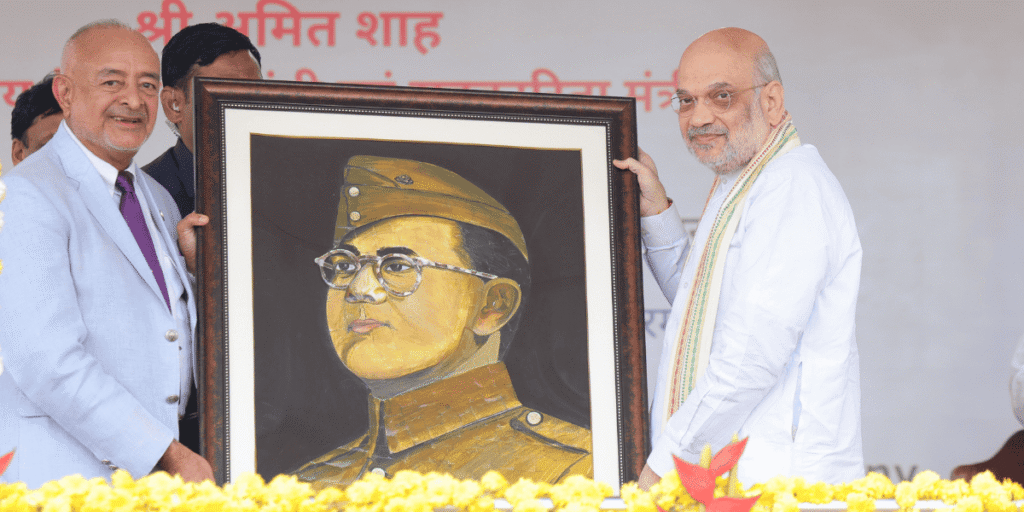
Recalling the historical legacy of the islands, Shah said the land bore witness to immense sacrifice during the freedom movement, particularly at the Cellular Jail, where countless freedom fighters endured imprisonment and torture. He noted that Netaji Subhas Chandra Bose’s unfurling of the Tricolour on the islands marked a defining moment in India’s struggle for independence and continues to inspire the nation.
The Home Minister said the renaming of islands as Shaheed and Swaraj, and the renaming of Port Blair as Sri Vijaya Puram, reflected the government’s resolve to shed colonial symbols and honour national heroes. Memorials dedicated to Param Vir Chakra awardees, he added, further underline the islands’ role in preserving the legacy of sacrifice and courage.
Among the major projects inaugurated was an Integrated Command and Control Centre built at a cost of ₹229 crore, aimed at strengthening surveillance, coordination and response mechanisms across India’s maritime boundaries. Officials said the facility will play a crucial role in enhancing national security and monitoring across the island chain.

Shah also inaugurated a DNA and Cyber Forensic Laboratory to bolster scientific investigation and cybercrime detection capabilities, a move seen as critical for improving law enforcement efficiency in the region.
In the healthcare sector, Phase I of a 155-bedded hospital along with a 50-bedded Intensive Care Unit was inaugurated, significantly expanding access to advanced medical facilities for island residents. Shah said strengthening healthcare infrastructure in remote and island regions remains a priority for the government.
Connectivity and institutional infrastructure projects were also highlighted, including the inauguration of a road linking Zero Point to the East–West Road in the Great Nicobar Block to improve access and mobility in one of the most remote parts of the territory, and a new Consumer Commission Building to strengthen administrative capacity.
Shah said foundation stones were laid for two additional development works, reflecting the government’s long-term commitment to the islands. He added that the overall package of projects demonstrated a balanced approach that integrates security imperatives with economic development and public welfare.

Referring to the rollout of new criminal laws replacing colonial-era legislation, the Home Minister said the reforms are designed to ensure dignity, equality and timely justice for citizens. An exhibition on the new laws was inaugurated at the ITF Ground to raise public awareness, with Shah urging legal professionals, students and citizens to familiarise themselves with the changes aimed at reducing delays and improving the efficiency of the justice delivery system.
Shah said the Andaman and Nicobar Islands occupy a vital position in the Indo-Pacific region and hold immense potential in areas such as tourism and the blue economy. With improved infrastructure and governance, he said, the islands are expected to contribute more significantly to national growth while strengthening India’s strategic footprint as the country moves towards its development roadmap for 2047.