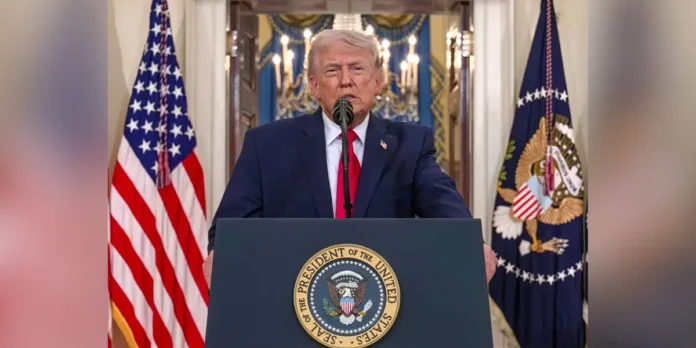
Sri Vijaya Puram, November 5: US President Donald Trump has suffered a major political setback after Democrats secured control of both chambers of Congress in the November 3 midterm elections, delivering a sweeping electoral reversal for Republicans and setting the stage for a divided government when the new Congress takes office in January 2027.
The Democratic victories across traditionally Republican strongholds, competitive congressional districts and key gubernatorial contests have reshaped the political landscape in Washington, leaving Trump’s administration facing an opposition-controlled Congress for the remaining two years of his presidency.
The results also raised questions about Republican leadership, the party’s electoral strategy and the political consequences of the administration’s policies, particularly the rising cost of living, healthcare concerns and the US military campaign against Iran.
Trump congratulated the Democrats on their victories but attributed the Republican losses partly to his absence from the ballot, arguing that the outcome would have been different had he personally contested the election.
“My message is, congratulations to the Democrats, and I look forward to working with you for the good of our country,” Trump told CBS News in an election-night telephone interview.
He maintained that Republican candidates had struggled to convert enthusiasm for his leadership into votes, despite his campaign appearances and efforts to support them.
“We weren’t able to transfer the love to candidates,” he said, adding that Republicans would have won had his name appeared on the ballot.
The President also reminded Democrats that he retained constitutional veto powers, signalling that any major legislative changes would require negotiations with the White House.

Democrats claim mandate for change
Senate Democratic leader Chuck Schumer described the outcome as a breakthrough that few had anticipated when the election campaign began. Celebrating the party’s return to control of the Senate, he said Democrats had overcome considerable political odds.
“Against all odds, we Democrats have won the Senate,” Schumer said at a news conference in Washington on Wednesday, adding that “relief is on the way.”
He attributed the victories to growing public dissatisfaction over household expenses, healthcare costs and the direction of the administration’s economic policies. According to Schumer, Democratic candidates succeeded by addressing issues affecting ordinary American families and appealing to voters beyond the party’s traditional support base.
House Democratic leader Hakeem Jeffries, who is positioned to become the first Black Speaker of the House, described the election as a clear demand for political change.
“This is a change election,” Jeffries told supporters at the party’s election-night gathering.
He pledged that the incoming Democratic majority would prioritise reducing housing, grocery and fuel costs, restoring healthcare protections and increasing accountability in government. Democrats also indicated that they would use their congressional authority to examine executive decisions and investigate allegations of corruption involving the administration.
Democratic National Committee Chairman Ken Martin said the results represented a mandate to address affordability, healthcare, immigration and government accountability. He also signalled opposition to the administration’s tariff policies and its handling of the conflict with Iran.
Republican strongholds fall
The scale of the Democratic advance was particularly significant because the party made gains in states that have traditionally supported Republican candidates.
By early Wednesday, Democrats had secured at least 54 Senate seats and crossed the 218-seat threshold required for a majority in the House, according to projections by CBS News and Fox News.
The victories included seven Republican-held Senate seats, with Texas and Kansas emerging as two of the biggest surprises.
In Texas, Democrat James Talarico defeated Republican Ken Paxton, becoming the first Democrat elected to the US Senate from the state since 1988. Democrat Gina Hinojosa also defeated three-term Republican Governor Greg Abbott, ending more than three decades without a Democratic gubernatorial victory in the state.
Kansas witnessed another historic reversal, with Democrat Adam Hamilton defeating Republican Senator Roger Marshall to secure the party’s first Senate victory there since 1932.
In Ohio, former Democratic Senator Sherrod Brown defeated Republican Senator Jon Husted, while Democrat Amy Acton defeated Indian-American Republican Vivek Ramaswamy in the gubernatorial contest. Acton became the first woman elected Governor of Ohio.
Democrats also secured important victories in Iowa, Maine, North Carolina and South Carolina, while retaining key Senate seats in Georgia, Michigan and New Hampshire. Abdul El-Sayed’s victory in Michigan also made him the first Muslim elected to the US Senate.
The party’s gains extended to gubernatorial elections, with former Atlanta Mayor Keisha Lance Bottoms winning in Georgia and becoming the first Black woman elected Governor in US history. Republicans, however, retained some important positions, including Florida’s governorship, won by Byron Donalds.
Iran war takes political toll
Adding another dimension to the Republican setback, Trump acknowledged on Wednesday that the war with Iran had contributed to the party’s poor electoral performance, particularly through its impact on petrol prices.
Asked whether the conflict had hurt Republican candidates, Trump said the assessment was largely correct, acknowledging that the military operation had pushed fuel prices higher in the short term.
However, he defended the decision to launch the operation, insisting that preventing Iran from acquiring nuclear weapons remained a national security priority.
“If I had it to do again, I’d have to do it again,” he told reporters, maintaining that the military campaign had significantly weakened Iran’s military capabilities.
Trump also dismissed suggestions that the electoral setback would change his approach to the conflict, saying the fighting would end only when the desired outcome had been achieved.

Republican leadership under scrutiny
Republican leaders acknowledged the defeat but sought to place it within the historical pattern of midterm elections, in which the party holding the presidency frequently loses congressional seats.
House Speaker Mike Johnson said Republicans had faced difficult electoral circumstances and cautioned against using congressional oversight as an instrument of political retaliation.
Senate Republican leader John Thune defended the administration’s record, citing tax policies, border security, judicial appointments and economic measures as achievements despite the losses.
The results have nevertheless triggered discussions within Republican ranks about leadership and the party’s future direction. Republican Congressman Ralph Norman described the outcome as a wake-up call for conservatives, while the party is expected to hold leadership elections next week.
With Democrats preparing to take control of both chambers in January 2027, the final two years of Trump’s presidency are likely to be marked by sharper congressional scrutiny and legislative negotiations.
While Trump retains executive authority and the power to veto legislation, Democrats will control congressional committees, investigations and the legislative agenda, giving the opposition party significant influence over the political direction of the United States.