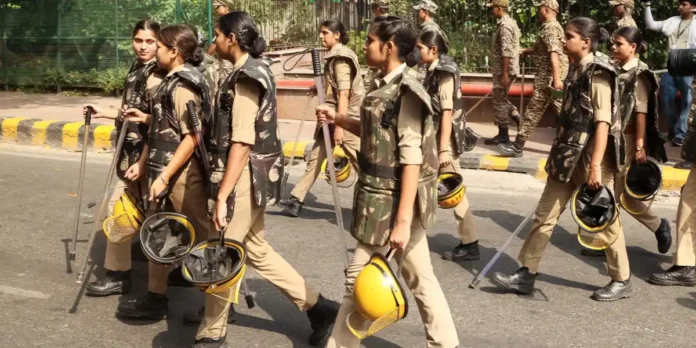
New Delhi, Oct 27: The Supreme Court has sought the Centre’s response to a plea for a nationwide protocol to safeguard women police personnel during protest deployments, independently investigate allegations of misconduct and violence, and authenticate digital evidence, including potentially manipulated material circulated on social media.
A Bench comprising Chief Justice of India Surya Kant and Justices Joymalya Bagchi and V. Mohana issued notice on Tuesday on the public interest litigation filed by advocate Ashish Gopal Garg. The court tagged the petition with a group of pending petitions and scheduled the matter for further hearing on November 3.
Filed through advocate-on-record Shweta Garg, the petition seeks a comprehensive framework governing the deployment and protection of women police personnel during public-order duties. It also calls for safeguards to preserve electronic evidence and establish its authenticity, alongside independent scrutiny of complaints involving alleged misconduct by police personnel and violence against them.

The plea refers to recent protests in Delhi over the Special Intensive Revision (SIR) of electoral rolls and demands for the resignation of Chief Election Commissioner Gyanesh Kumar. It cites allegations of violence against police personnel, including women officers and constables, and the circulation of digitally manipulated material on social media.
The petitioner argues that women personnel deployed in crowded and volatile protest situations face risks that require specific safeguards, including mechanisms to report and address sexual harassment in the field. The plea also raises concerns about disputed digital content being presented to investigating agencies or courts before its authenticity has been independently established.
It contends that the absence of a published, uniform protocol leaves gaps in the protection of women personnel, the handling of complaints against police staff and the verification of electronic material linked to protests.

The petition proposes a Women Police Personnel Protection and Protest Management Protocol, with provisions for retaining CCTV footage, body-worn camera recordings, control-room footage and other relevant electronic records. It also seeks a framework for forensic authentication of disputed digital material and an effective complaint mechanism for women police personnel.
The petitioner has argued that the legal framework must protect peaceful assemblies while ensuring that allegations of violence, unlawful use of force and sexual misconduct are addressed in accordance with law and on the basis of reliable evidence.
The plea seeks independent examination of allegations involving police personnel, alongside safeguards against violence directed at them. The Supreme Court’s notice seeks the Centre’s response; the petition’s requests remain matters for consideration by the court.