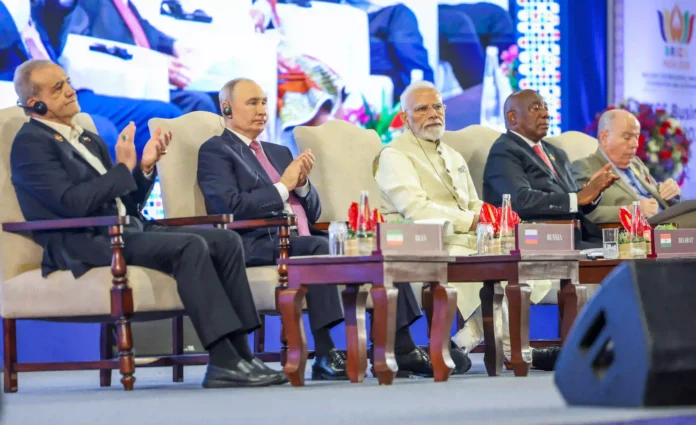
New Delhi, Sept. 12: India has steered BRICS members towards consensus on a Joint Statement after intensive negotiations that continued until early Saturday, overcoming sharp differences among countries facing competing geopolitical positions. The statement is expected to be released later on Saturday, the opening day of the 18th BRICS Summit at Bharat Mandapam in New Delhi.
Sources said India conducted sustained consultations from Friday through around 4 a.m. on Saturday to narrow differences and secure agreement among the expanded grouping. The negotiations covered several contentious issues, with the diplomatic challenge heightened by the presence of Iran, Saudi Arabia and the United Arab Emirates in the same forum despite their divergent positions on regional and geopolitical matters.
The consensus assumes added significance amid continuing conflicts and heightened tensions in West Asia. Sources said India’s negotiations prevented those differences from disrupting the BRICS process and enabled members to agree on a common document.

The development comes after the BRICS ministerial summit in New Delhi in May ended without the bloc issuing its customary joint statement for the first time. At that meeting, divisions between Iran and the UAE prevented consensus, prompting India to issue a Chair’s Statement and Outcome Document instead.
India’s handling of the latest negotiations has drawn attention to its effort to maintain dialogue within a grouping whose members hold substantially different positions on major geopolitical questions. Prime Minister Narendra Modi and India have consistently backed dialogue and diplomacy as the means of resolving conflicts, while stressing that this is not an era of war and that solutions cannot emerge from battlefields.
During its BRICS chairship, India has also sought to advance the interests of the Global South without positioning the grouping as anti-Western, following a similar approach during its G20 Presidency.

A recent report in Australia-based The Interpreter highlighted the challenges facing India’s balancing role within BRICS. It described the grouping as contested terrain, noting that the expansion of its membership, opposed by India and Brazil, has made consensus more difficult.
The report also identified a broader divide within the grouping: India and Brazil largely view BRICS as an economic platform, while China and Russia approach it more as a geopolitical grouping.
It said India considers itself a reformist rather than revisionist power and seeks a larger role in global governance, including a permanent seat on the UN Security Council and greater influence over financial and technological rulemaking. India’s approach seeks changes in parts of the international order while retaining the broader system that has supported its own rise.