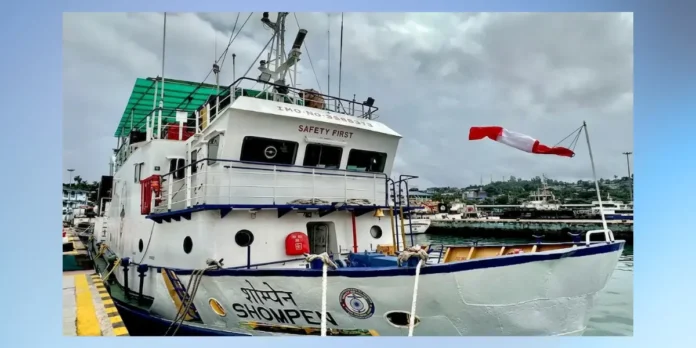
Sri Vijaya Puram, August 17: The deployment of MV Shompen, a vessel specifically rededicated as a hospital ship to strengthen healthcare access across the Andaman and Nicobar Islands, on scheduled passenger services has raised questions over the availability and utilisation of dedicated medical transport in the archipelago.
The issue has assumed greater significance following the reported deaths of two critically ill patients on August 8 while they were being transferred from the Community Health Centre at Rangat to Sri Vijaya Puram aboard a routine Directorate of Shipping Services (DSS) speedboat.
MV Shompen, meanwhile, is currently being deployed on scheduled passenger services on the Campbell Bay sector via Katchal and Nancowry, according to information available with The Wave Andaman.
Public health and maritime experts said the issue is not whether a hospital ship can also be deployed for passenger services when it is not required for medical duty. The larger question is whether the islands have adequate dedicated capacity to transport critically ill patients over long distances, and what alternative medical evacuation arrangement is available when a vessel specifically equipped for that purpose is deployed on routine passenger routes.
MV Shompen was rededicated as a hospital ship on September 20, 2024, with the objective of improving healthcare access for people living on remote islands. The vessel was equipped to transport 20 patients at a time, including 16 non-stretcher and four stretcher patients, along with arrangements for doctors and essential medical equipment. Plans were also announced to add a small operation theatre to expand its medical capability.
The vessel was envisaged as a floating healthcare platform that could conduct health camps in remote islands, provide primary and secondary healthcare and transport patients requiring specialised treatment to Sri Vijaya Puram.
DSS records show that MV Shompen has previously performed this role. According to the Directorate’s March 2025 newsletter, the hospital ship had transported 246 people, including patients, attendants and medical personnel, following its rededication. On January 28, 2025, it was used to evacuate five critically ill patients from Mayabunder to Sri Vijaya Puram.

A large but stretched fleet
MV Shompen operates within a substantially larger government shipping network.
According to DSS fleet information, the Directorate had 66 vessels as of October 31, 2025. These included eight inter-island vessels, 17 foreshore vessels, 11 harbour passenger ferries and 11 vehicle-cum-passenger ferries, besides one mainland vessel, five motor launches, four touring vessels, two cargo vessels and other utility craft.
The figure does not mean that 66 passenger vessels are available interchangeably. Maritime experts said different vessels are designed and certified for different purposes, while maintenance, dry-docking, surveys and repairs can reduce the number available at any given time.
The logistical challenge is considerable. DSS describes shipping as the lifeline of the islands, providing connectivity to 29 of the Union Territory’s 37 inhabited islands. The archipelago stretches over a large geographical area and is around 700 nautical miles from mainland India, making shipping essential for the movement of people, cargo and essential supplies.
In FY26, DSS operated 705 inter-island voyages carrying 203,410 passengers, while 5,772 foreshore voyages carried another 490,929 passengers, according to official data.
Maritime experts said maintaining such connectivity inevitably requires the administration to balance routine passenger requirements against emergency needs. But they said specialised vessels need clearly defined deployment protocols so that an alternative is available when they are assigned to other duties.
Healthcare challenge
The problem assumes greater importance because healthcare delivery in the Andaman and Nicobar Islands is itself constrained by geography.
While primary and secondary healthcare facilities are spread across the inhabited islands, much of the specialised and tertiary healthcare infrastructure is concentrated in Sri Vijaya Puram. Patients requiring advanced treatment from remote parts of the archipelago therefore frequently have to be referred to the capital.
GB Pant Hospital is the Union Territory’s principal referral hospital, while the Andaman and Nicobar Islands Institute of Medical Sciences provides specialist and tertiary services. For residents of North and Middle Andaman and the southern group of islands, reaching these facilities can require lengthy journeys involving road and sea transport.
Patients referred from Campbell Bay, Car Nicobar, Nancowry, Diglipur, Mayabunder or Rangat can consequently face a very different medical transportation challenge from patients on the mainland, where tertiary hospitals may often be accessible by road.
The administration uses a combination of road ambulances, ships and, in some emergencies, helicopters for patient transfers. The Directorate of Health Services says emergency patients can be evacuated from remote locations, including Car Nicobar and Campbell Bay.
Health experts said transportation of a critically ill patient cannot be viewed simply as moving a passenger from one location to another. Depending on the patient’s condition, the journey may require oxygen, continuous monitoring, trained medical personnel, resuscitation equipment and the ability to respond if the patient’s condition deteriorates.

Weather, sea conditions, distance and the availability of vessels or helicopters can further complicate an evacuation.
It was precisely this structural gap that MV Shompen’s conversion into a hospital ship was intended to help address — providing an option for transporting patients by sea in a vessel equipped for medical movement rather than depending entirely on vessels primarily configured for ordinary passenger services.
The August 8 deaths have therefore brought renewed attention to how that system is functioning.
There is no evidence at this stage to establish that MV Shompen was available near Rangat on August 8, that it could have reached the patients within the required timeframe, or that transporting them aboard the hospital ship would have changed the medical outcome. Health and maritime experts said reaching such a conclusion would require information about the patients’ medical condition, urgency of the referral, location of the vessel and evacuation options available at the time.
The incident nevertheless raises broader questions over how the islands’ medical evacuation architecture works.
Experts said there needs to be clarity over how frequently MV Shompen remains available for medical duty, when it can be deployed for passenger services, whether its medical equipment and staffing are maintained during such deployments and, most importantly, what alternative suitably equipped vessel is immediately available when a critical patient needs to be moved.
They also pointed to the need for coordination between health authorities and DSS so that decisions on transporting critically ill patients take into account their medical requirements, travel time, weather and the level of medical support required during the journey, rather than merely the availability of the next passenger vessel.
The Wave Andaman has written to the Directorate of Shipping Services seeking clarification on MV Shompen’s present deployment, the number of medical evacuations undertaken by the vessel and the alternative arrangements available when it is operating passenger services. The publication had raised questions over the vessel’s deployment nearly a year ago as well. A response was awaited at the time of publication.
For an island chain where geography can determine how quickly a critically ill patient reaches specialised treatment, experts said the issue extends beyond the deployment of one ship. MV Shompen was rededicated to help bridge precisely this gap. The larger question is whether the medical evacuation system ensures that such specialised capability remains available when patients need it most.