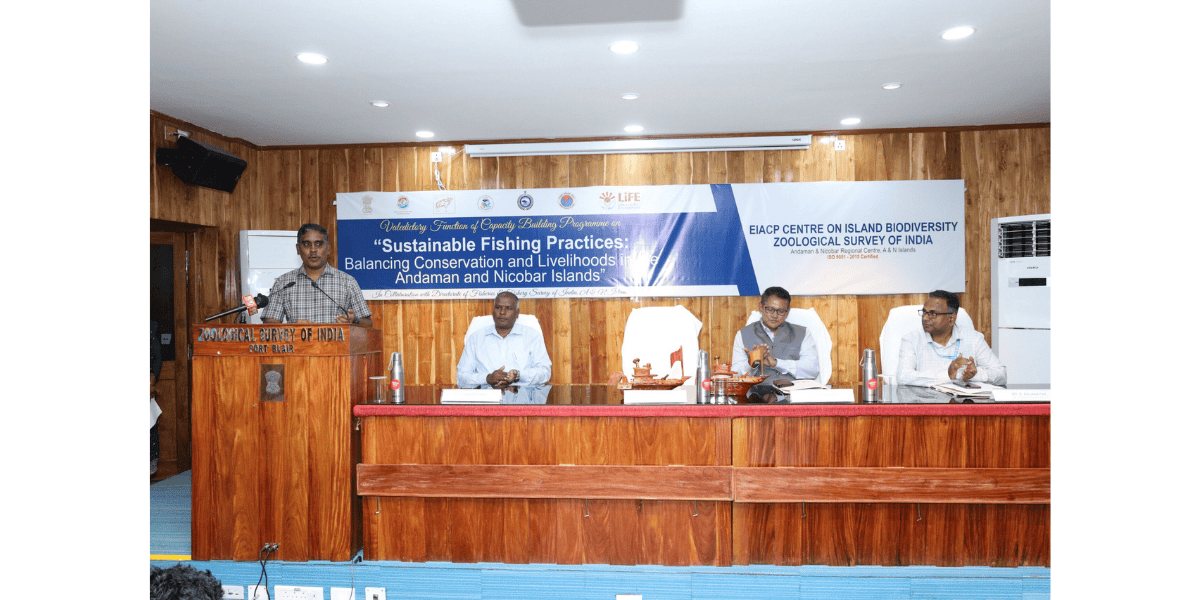
A two-week capacity building programme focused on sustainable fishing practices and marine conservation concluded on January 24 at the Zoological Survey of India, Andaman and Nicobar Regional Centre, marking a significant outreach effort aimed at balancing ecological protection with the livelihoods of island fishing communities.
The programme, organised by the EIACP Centre on Island Biodiversity under the Zoological Survey of India in collaboration with the Directorate of Fisheries and the Fishery Survey of India, was conducted from January 7 to January 24 across seven locations, Panighat, Guptapara, Junglighat, Dignabad, Wandoor, Sri Vijaya Puram and Baratang. It was designed to strengthen sustainable fisheries management in the ecologically sensitive island ecosystem while addressing socio-economic realities faced by coastal communities.
A total of 372 participants took part in the programme, including fishermen, students from Pondicherry University and leaders from coastal communities. The training combined technical lectures with practical, hands-on sessions that highlighted the unique ecological and economic significance of the Andaman and Nicobar Islands. Participants were exposed to contemporary fisheries management concepts alongside field-level realities of fishing in island waters.
Two specialised hands-on modules formed a key component of the training. These included sessions on navigation and seamanship at Junglighat Fishing Harbour and demonstrations on tuna fishery resources within the Indian Exclusive Economic Zone, conducted with support from the Fishery Survey of India. The modules were aimed at improving technical proficiency while familiarising participants with ecosystem-based management and scientific assessment of fishery resources.
The valedictory function was attended by senior officials and experts from environment, agriculture and fisheries institutions. Addressing the gathering, Chief Conservator of Forests (Wildlife), Department of Environment and Forests, highlighted conservation and sustainability as central pillars of fisheries management and emphasised the importance of preventing overexploitation of natural resources. The programme’s field-oriented approach, which brought training directly to fishing communities and students, was highlighted as a strength, with participants encouraged to act as ambassadors for conservation in their respective localities.
The Director-in-Charge of ICAR-Central Island Agricultural Research Institute drew attention to the growing challenges posed by climate change, including biodiversity loss, rising sea surface temperatures and extreme weather events. He underlined the need for innovative and ecologically sound solutions to meet future food demands without expanding land use, while also stressing the fisheries potential of the Andaman Islands. Emphasis was placed on responsible and planned harvesting, integration of scientific and technological methods with traditional knowledge systems, and the role of community-based conservation practices, particularly in the Nicobar Islands.
The Mechanical Marine Engineer from the Fishery Survey of India highlighted the importance of balancing aquatic biodiversity conservation with the economic stability of fishing communities. He noted that experiential learning on sustainable harvesting, policy frameworks and ecosystem-based management enhanced participants’ understanding beyond technical skills, encouraging value-based and action-oriented learning. The programme was described as a starting point for continued cooperation rather than a standalone initiative.
Earlier, the Additional Director of ZSI and Programme Coordinator of the EIACP Centre on Island Biodiversity outlined the programme’s objectives, which included addressing overfishing, habitat degradation and marine pollution through best practices and responsible fishing methods. He acknowledged the support of the Ministry of Environment, Forest and Climate Change, Directorate of Fisheries and Fishery Survey of India, as well as the efforts of resource persons and the EIACP team.
The programme concluded with the distribution of certificates to participants, reinforcing the emphasis on sustained engagement, long-term behavioural change and the shared responsibility of conserving marine biodiversity while securing livelihoods in the Andaman and Nicobar Islands.