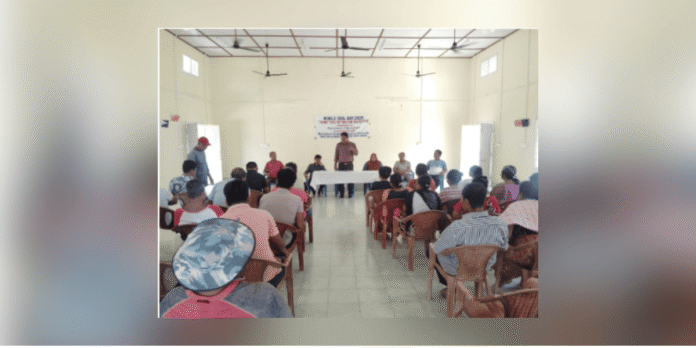
World Soil Day was observed across Car Nicobar and Campbell Bay on December 5, with the Department of Agriculture leading parallel programmes that sought to draw attention to soil health, organic waste utilisation and sustainable farming practices in the islands. The events, themed “Healthy Soils for Healthy Cities,” brought together farmers, agriculture officials, scientists and community representatives in an effort to promote long-term ecological balance in local farming landscapes.
In Car Nicobar, the programme held at Malacca Village opened with an appeal to the farming community to strengthen soil health by putting farm and household waste to effective use. The chief guest urged cultivators to follow the recommendations prescribed in the Soil Health Cards that were distributed during the event, emphasising that productivity and soil resilience depend on farmers’ ability to adopt methods suited to local conditions. With many island farmers managing small and vulnerable plots, the message centred on maximising local resources rather than relying on external inputs.
The gathering was welcomed with an overview of the significance of World Soil Day, linking healthy soils to stable food systems, water security and climate resilience. Officials also stressed the role of soil conservation in the Andaman and Nicobar Islands, where weather fluctuations and geographic limitations can amplify the effects of soil degradation. The highlight of the session remained the distribution of Soil Health Cards, intended to guide farmers on the nutrient profile of their fields and recommend suitable interventions.

Experts from KVK–CIARI addressed the gathering, explaining the need for island farmers to adopt practices that prevent soil depletion. The conversations centred on managing organic matter, reducing avoidable soil disturbance and sustaining micronutrient availability. A session led by an Agriculture Officer provided practical explanations on composting methods, decomposition cycles and how farmers can convert routine organic waste into a long-term soil-enriching resource. With waste disposal remaining a challenge across many parts of the islands, officials emphasised that composting can address both waste management and soil fertility concerns simultaneously.
Simultaneously at Campbell Bay, a similar observance of World Soil Day was conducted at the Community Hall in Rajiv Nagar. The programme, inaugurated by the Chairman of the Tribal Council, sensitised the local farming community on the importance of soil management in achieving sustainable development goals and preventing irreversible ecological damage. Organisers highlighted the relevance of sustainable agriculture in remote regions where transportation, accessibility and resource availability often limit farming choices.
Speakers at the Campbell Bay programme addressed issues such as soil pollution, nutrient decline and the environmental toll of faulty land-use practices. Officials explained the consequences of ignoring soil health, particularly in ecologically delicate regions like the Great Nicobar Island. With agricultural land being both limited and increasingly pressured by climatic variations, the programme underlined the urgency of shifting to soil-friendly farming models.

Participants were also reminded that soil health is connected not only to agricultural yield but also to broader environmental factors. Veterinary officials highlighted the interdependence of soil quality, livestock health and community well-being, expanding the conversation beyond crop fields to the wider rural ecosystem. Soil Health Cards were also distributed to farmers at Campbell Bay, reinforcing the administration’s effort to equip cultivators with data-based assessments of their farm conditions.
By observing World Soil Day through multiple community-centred events, the Agriculture Department aimed to consolidate awareness on soil preservation across the islands. The programmes collectively underscored that improving soil health requires consistent community participation and practical adoption of sustainable methods. For many farmers in remote islands, the renewed focus on waste-to-compost techniques, nutrient monitoring and environmentally responsible practices is expected to serve as a foundation for strengthening agricultural resilience in the years ahead.