US President Donald Trump said American military operations against Iran were “going very well,” claiming that US forces delivered major strikes and significantly weakened Iran’s military capabilities as tensions escalated across the Middle East.
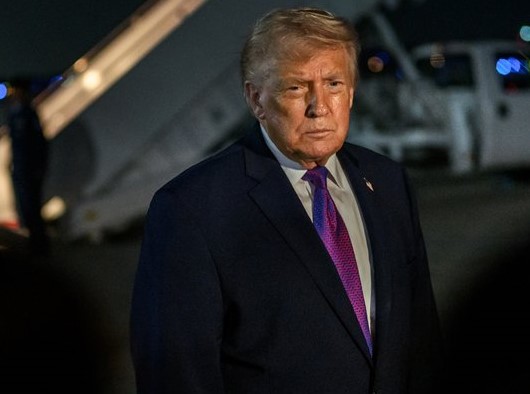
Speaking to reporters at Joint Base Andrews on Friday, Trump said the campaign had achieved substantial military gains and that US forces were maintaining firm control over the situation. He described the day’s operations as producing “very big hits” and “big wins,” signalling confidence in the progress of the ongoing conflict.
Trump said the military campaign aimed to eliminate what he described as a nuclear threat originating from Iran and insisted that the objective was being achieved through the current operations. According to him, the action was necessary to remove a threat that he said extended beyond the region to the wider world.

The US president also asserted that Iran’s armed forces had suffered extensive damage during the fighting. Responding to questions about the possibility of unconditional surrender, Trump said the United States had reached a position of dominance rarely seen before in modern conflicts. He claimed that Iran’s naval and air power had largely been destroyed and that the country’s broader military capacity had been severely diminished.
Trump further stated that Iranian air defence infrastructure had been heavily degraded. He said radar systems and anti-aircraft capabilities were mostly neutralised, suggesting that the country’s ability to defend its airspace had been drastically reduced.
When asked how long the conflict could continue, Trump declined to provide a specific timeline. However, he said the military campaign was advancing faster than anticipated and indicated that operations would continue for as long as required to meet their objectives.
“It’ll be as long as it’s necessary,” he said, adding that the United States was “way ahead of schedule” in the progress of the campaign.
Trump also addressed the potential economic consequences of the conflict, particularly its impact on global energy markets. He predicted that energy prices would fall once the situation stabilised, saying gasoline and other energy costs could drop significantly after the crisis subsides.
The remarks came as concerns grow about stability in the Gulf region, including the security of key shipping routes such as the Strait of Hormuz. The narrow waterway carries roughly one-fifth of the world’s oil supply and remains one of the most strategically sensitive maritime corridors for global energy trade.
Trump confirmed that he had discussed the situation with Xi Jinping, the president of China, saying the two leaders were in communication about the developments along with other matters.

He also acknowledged contact with Benjamin Netanyahu, the prime minister of Israel, though he suggested that Washington and Tel Aviv might not share identical strategic priorities in the conflict.
Despite those differences, Trump emphasised the scale of US military capability, saying the United States possessed unmatched power in the ongoing confrontation.
The comments came amid heightened regional tensions and growing international attention on how the expanding conflict could affect geopolitical stability and energy supply routes across the Middle East.