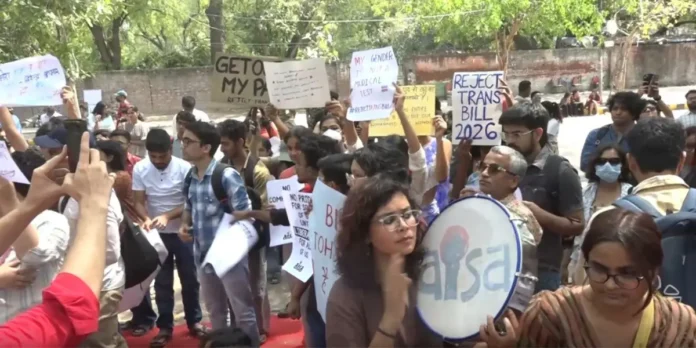
Opposition to the Transgender Persons (Protection of Rights) Amendment Bill, 2026 intensified on Thursday as transgender groups, rights collectives, and community organisations raised strong objections, calling the legislation regressive, exclusionary, and unconstitutional, even as protests were held at Jantar Mantar in the national capital.
The Joint Action Committee on Transgender and LGBTIQ+ Rights in Keralam, along with national collectives, said the Bill removes the right to self-perceived gender identity and shifts authority to state-appointed medical boards. The move introduces certification processes and administrative controls, which the groups argue undermine dignity, autonomy, and privacy, principles upheld by the Supreme Court in the landmark National Legal Services Authority vs. Union of India ruling.
Protesters at Jantar Mantar echoed these concerns, stating that the Bill, passed by both Houses of Parliament and now awaiting presidential assent, weakens the legal protections earlier granted to transgender persons. They said the legislation reverses the recognition of self-identification affirmed in previous legal frameworks and instead imposes a medicalised approach to identity.

Criticism has also focused on the Bill’s revised definition of “transgender person,” which narrows its scope to certain socio-cultural identities. Community leaders argue that this excludes large sections, including trans men, transmasculine individuals, non-binary and genderqueer persons, as well as trans women who do not fit within the specified categories. They contend that this change effectively erases diverse identities without adequate data, study, or consultation with stakeholders, including the National Council for Transgender Persons.
Another point of concern is the inclusion of broad penal provisions, which activists warn could be misused against members of the community and those supporting them, including healthcare professionals, educators, and families. They argue that such provisions create an environment of mistrust and potential criminalisation.
Kerala’s experience has been cited as a contrast, where the state’s transgender policy introduced in 2015 led to welfare initiatives that improved social inclusion and access to services. Activists caution that restricting identity recognition at the national level could undermine such gains and limit access to welfare systems.
The impact of the proposed changes is already being felt within the community, according to advocacy groups. Reports from various states indicate rising anxiety, distress, and fear, with concerns about increased vulnerability to mental health crises, including risks of self-harm and suicidality.

At the protest site, demonstrators demanded the withdrawal of the Bill, alleging that it had been introduced without meaningful consultation. Some participants said the legislation undermines equality and dignity, while others argued it allows the state to determine identity, stripping individuals of personal agency.
In response to the developments, the Joint Action Committee announced plans to convene a state-level convention in Kerala. The gathering will bring together community members, legal experts, mental health professionals, and allies to outline future advocacy strategies. The group also intends to initiate a legal consultation process to examine constitutional challenges and explore judicial intervention.
The Rajya Sabha passed the Bill a day after its approval in the Lok Sabha, despite opposition members calling for it to be referred to a select committee for further scrutiny.



