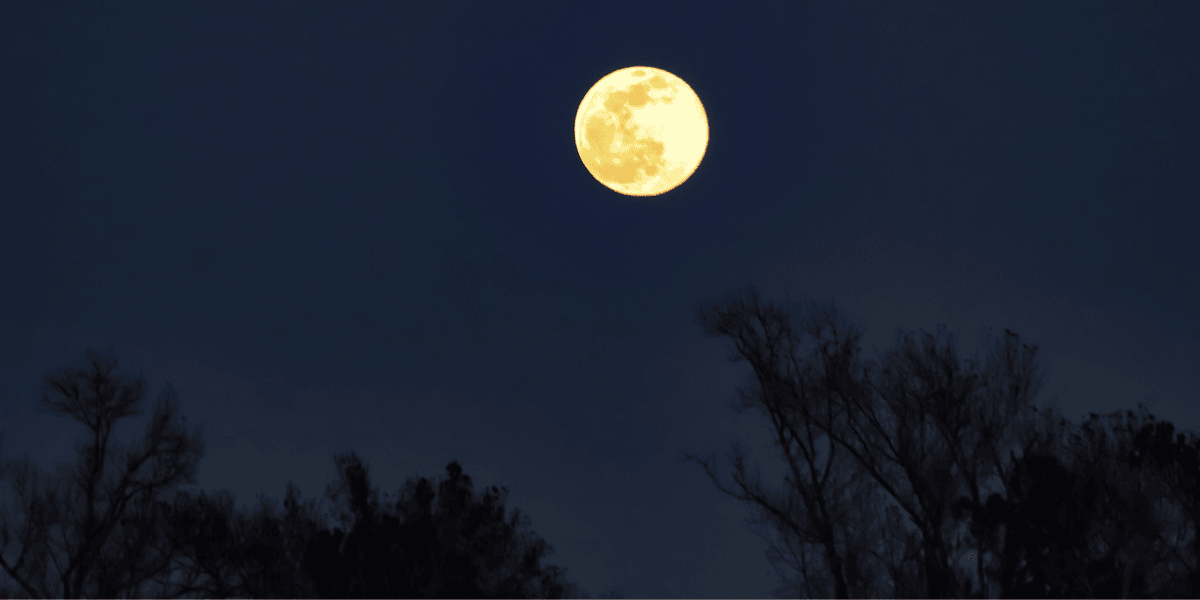
A total lunar eclipse will occur today, March 3, marking the first lunar eclipse of 2026 and bringing limited visibility across parts of India while offering clearer viewing conditions across the Pacific region.
In India, the eclipse will begin at 3:20 p.m. and continue until approximately 6:47 p.m. or 6:48 p.m., depending on regional calculations. The event will unfold as a rising eclipse, meaning its visibility will depend on local sunset timings. In Uttar Pradesh, observers are expected to witness the phenomenon mainly in regions where sunset occurs between 4 p.m. and 4:30 p.m., particularly in the northeastern belt. Central and western parts of the country are not expected to see the eclipse because the Moon will remain below the horizon during the key phases. In Bihar, visibility is projected to last for around 20 minutes.

Astronomically, the event will be a total lunar eclipse, commonly referred to as a blood moon. During totality, the full Moon will pass completely through Earth’s umbral shadow and is expected to take on a deep copper-red hue for nearly an hour.
The complete sequence, including penumbral, partial and total phases, is expected to span approximately five and a half hours, placing it among the longer lunar eclipses recorded in recent years. Totality will occur between 11:04 UTC and 12:03 UTC, with the mid-eclipse calculated at around 11:33 UTC. At that stage, the Moon will be positioned deepest within Earth’s shadow and the red coloration will appear most pronounced.

Globally, the eclipse will be best visible across eastern Asia, Australia, New Zealand and large parts of North America, where observers will have the Moon above the horizon during totality. Most of Europe and Africa will not have visibility, while viewing conditions in South Asia will remain limited or absent during the crucial phases.
The March 3 event forms the third in a sequence of four closely spaced lunar eclipses occurring between 2025 and 2026, sometimes described as an almost tetrad. It will also be the last total lunar eclipse visible worldwide until late 2028, increasing its astronomical significance for observers across regions.