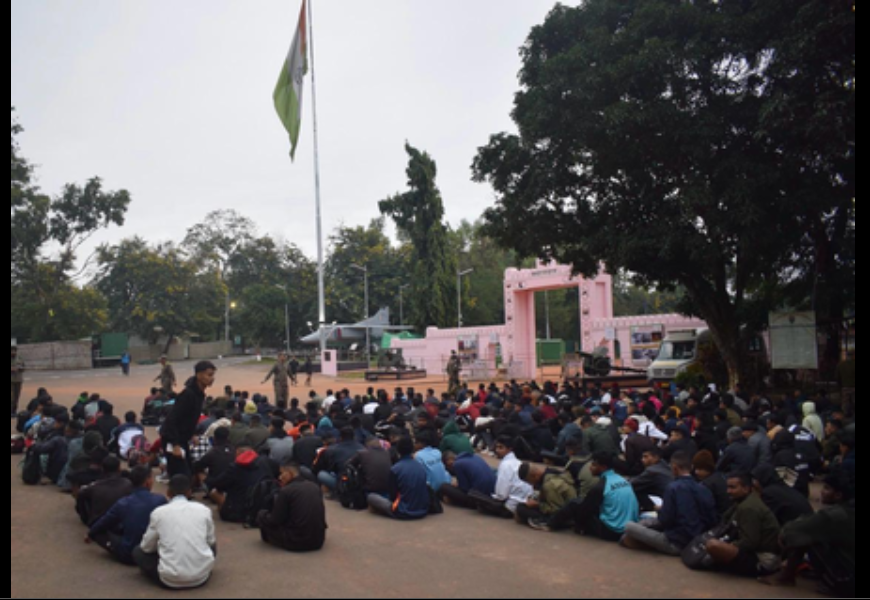
A massive turnout marked the Territorial Army recruitment rally held in Dimapur, Nagaland, where over 6,000 aspirants from across 10 states and Union Territories, including the Andaman and Nicobar Islands, participated in what officials described as one of the most extensive multi-state military recruitment drives seen in the Northeast in recent years.
The 15-day rally, conducted by the 113 Infantry Battalion (Territorial Army) Rajput, concluded on November 29, drawing candidates from all seven Northeastern states, West Bengal, Sikkim and the Andaman and Nicobar Islands. Officials said the scale and diversity of participation underscored rising interest in the Territorial Army among youth from geographically remote, high-altitude and previously sensitive regions.
According to officials associated with the exercise, the turnout reflected not only strong national aspiration among the youth but also an improved security environment and greater confidence in movement across the region. The ability of aspirants to travel long distances to attend the rally was cited as an indicator of growing stability and connectivity in the Northeast.
The rally was conducted in a counter-insurgency environment and required sustained coordination over two weeks, with thousands of candidates processed through multiple testing stages. Officials highlighted the operational planning and execution by the organising battalion, noting that the recruitment process adhered strictly to principles of fairness, transparency and merit.
Candidates underwent physical fitness tests, physical measurement tests, documentation checks and medical examinations under close supervision. The process was structured to ensure uniform standards across categories, with monitoring mechanisms in place to prevent irregularities and technical disqualifications.
Several facilitation measures were introduced during the rally to support aspirants, particularly those arriving from remote districts. These included dedicated assistance counters for documentation, special help desks for hill-area candidates, and free photocopying and form-related services. Officials said these steps helped ensure that eligible candidates were not excluded due to procedural or logistical hurdles.
Basic amenities were also arranged at the rally site, including organised free food, drinking water points, rest shelters and guidance booths for candidates who cleared physical events. Integrated traffic and crowd management arrangements were implemented in coordination with civil agencies to handle the large influx of participants smoothly.
The Dimapur civil administration and police provided logistical and security support throughout the rally, assisting with traffic control, crowd regulation and civic coordination. Officials acknowledged that cooperation from local residents also played a role in creating a safe and orderly environment during the recruitment exercise.
Observers described the rally as setting a new benchmark for large-scale military recruitment in the region, given its scale, organisation and people-centric approach. The exercise is being seen as a reference model for conducting youth-oriented employment initiatives under challenging terrain and operational conditions.
Officials noted that beyond recruitment figures, the rally strengthened engagement between the armed forces and civil society, particularly among young people in the Northeast and island regions. The successful conduct of the event, they said, reflected high organisational standards and contributed to reinforcing trust and participation in national institutions.