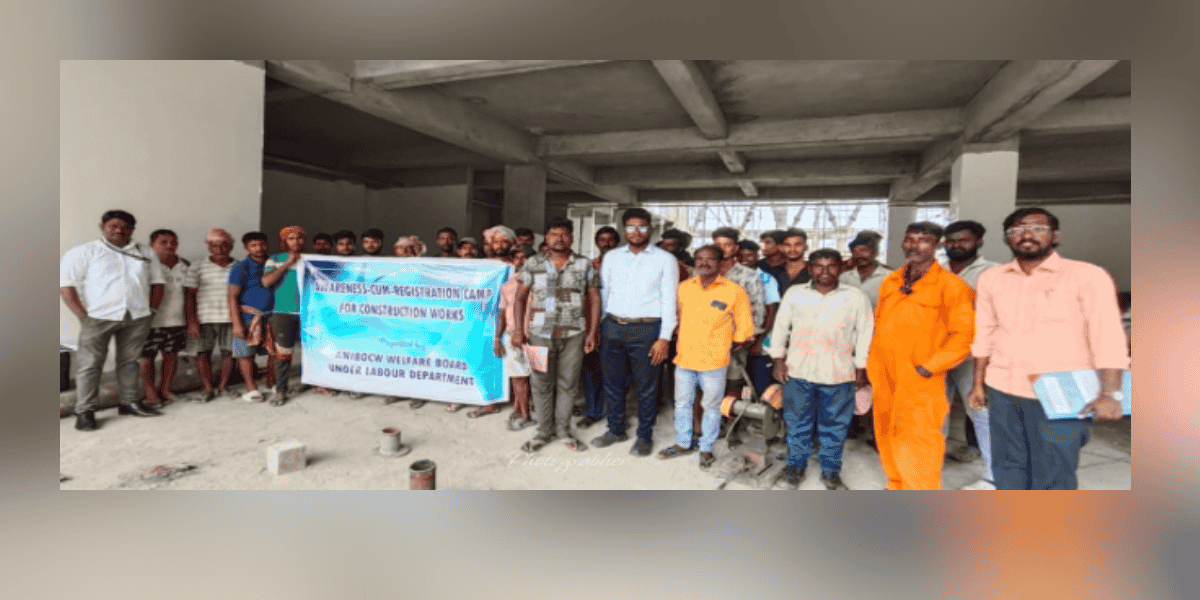
The Andaman and Nicobar Islands Building and Other Construction Workers Welfare Board concluded a series of awareness-cum-registration camps at Swaraj Dweep between September 24 and 26, bringing together migrant and local construction workers under one roof to highlight the importance of social security benefits. The initiative reflects a growing recognition of the precarious working conditions faced by laborers in the islands’ booming construction sector.
Over the course of three days, seven separate camps were organized across the island, recording the participation of nearly 150-160 workers. Many of them were migrant laborers who had arrived in the islands in search of better livelihood opportunities. The camps provided a platform for workers to interact directly with officials of the Welfare Board and gain clarity on the procedures, eligibility, and benefits available under different social security schemes.
A key outcome of the camps was the receipt of 85 registration applications from workers seeking to be formally enrolled as beneficiaries of the Welfare Board. For many, this was their first attempt to access institutional support, as migrant and unorganized laborers often remain outside formal safety nets due to lack of awareness or documentation.

The organizers underscored that registration with the Welfare Board is not merely a formality but a pathway to concrete benefits. Registered workers gain access to schemes covering health, education support for children, accident relief, maternity benefits, pension plans, and financial assistance for housing. In an environment where construction work is both physically demanding and uncertain, such protections provide a crucial cushion.
Officials used the sessions to walk participants through the practical aspects of enrollment. Workers were informed about the documents required, the timelines for approval, and how benefits can be availed without middlemen. The camps also sought to dispel misconceptions about eligibility, particularly among migrant workers who often assume they cannot access welfare support in the islands.
The presence of migrant workers at these camps highlights the dual challenge faced by the Andaman and Nicobar Islands. On one hand, the administration seeks to expand infrastructure to support tourism and connectivity; on the other, the influx of labor creates an urgent need to ensure welfare and security for those who power these projects. The welfare camps attempt to bridge this gap by bringing unorganized labor into a more structured framework.
Participants acknowledged that such camps reduce the distance between government schemes and the working population. While some workers registered on the spot, others left with forms to be completed after arranging necessary documentation. Officials indicated that follow-up measures will be undertaken to ensure that applications are processed without delay.
The camps also functioned as awareness sessions about occupational safety. Workers were reminded about the importance of protective gear, safe working practices, and reporting unsafe conditions. This reflects a growing emphasis on not only financial welfare but also the physical well-being of those engaged in construction.
For Swaraj Dweep, a popular tourist destination, the camps carry added relevance. Construction activity is brisk, ranging from resorts to civic infrastructure, and much of the workforce comprises short-term migrants. By registering them under welfare schemes, the administration aims to reduce vulnerabilities and promote inclusive growth.

The initiative also underlines a broader effort by the A&N Administration to bring informal workers into the social security fold. Given the geographical isolation of the islands and the seasonal nature of much employment, creating awareness is often the biggest hurdle. Camps such as these demonstrate a model of outreach that can be replicated across other islands where construction and unorganized labor play a vital role.
As the camps concluded, the message was clear: a workforce that contributes significantly to island development deserves the protection of welfare measures. The 85 applications received mark a step towards formalizing the status of workers, but equally important is the awareness generated among the larger group of participants. For many, this marks the beginning of a relationship with a system that recognizes their contribution and seeks to safeguard their future.