Once a quiet island inhabited by a small Yanadi tribal community, Sriharikota today stands at the centre of India’s journey into outer space. The transformation of this remote coastal landscape into one of the world’s recognised launch sites reflects the vision of India’s early space pioneers and the careful evolution of the country’s space programme.
The island that now hosts the Satish Dhawan Space Centre was once home to the Yanadi tribal community, a traditional forest-dwelling group that lived along the wetlands and coastal stretches of the region. For decades, Sriharikota remained largely isolated, surrounded by water bodies and dense vegetation, far removed from urban settlements. It’s quiet geography, however, would eventually become the very reason it was chosen for a national scientific mission that would propel India into space.
The turning point came in the early 1960s when Vikram A. Sarabhai began shaping India’s space ambitions under the Indian Space Research Organisation. Sarabhai envisioned that advanced technologies, particularly satellites and launch vehicles, could help address developmental challenges in communication, meteorology, and resource management. For this vision to take shape, India needed its own launch facility.

Scientists began searching for a suitable site along the eastern coast of the country. The location had to meet strict criteria: it needed to be far from dense human settlements for safety reasons, positioned close to the sea so that rocket trajectories could pass over open water, and provide a wide azimuth corridor for launching satellites into different orbits.
Sriharikota fulfilled all these requirements. The island lies between the vast waters of Pulicat Lake and the Bay of Bengal, forming a natural barrier island with minimal habitation. Its geographical isolation and long stretch of coastline made it ideal for rocket launches. What had once been a quiet tribal island port thus became the foundation for India’s space launch infrastructure.
The spaceport became operational on October 9, 1971, with the launch of the small sounding rocket Rohini-125. This modest beginning marked the start of India’s launch operations from Sriharikota and laid the groundwork for the development of indigenous launch vehicles. Over the decades, the infrastructure at the centre expanded gradually to support increasingly sophisticated rockets such as the Satellite Launch Vehicle, Augmented Satellite Launch Vehicle, Polar Satellite Launch Vehicle, and later the Geosynchronous Satellite Launch Vehicle and GSLV Mk III.
For many years the facility was known simply as the Sriharikota Range, or SHAR. In 2002, it was renamed the Satish Dhawan Space Centre SHAR in memory of Satish Dhawan, whose leadership helped consolidate India’s space programme and strengthen the country’s launch capabilities.
Today the space centre covers nearly 43,000 acres, with about 50 kilometres of coastline along the Bay of Bengal. Despite the extensive launch infrastructure and technological facilities, much of the island retains its natural ecological character. The landscape is dominated by eucalyptus plantations, shrub forests, and dense jungle vegetation, interspersed with groves of coconut, palm, and cane. Scattered shallow freshwater ponds add to the ecological diversity of the region.

Recognising the environmental sensitivity of the island, authorities have undertaken sustained efforts to balance technological development with conservation. Forest regeneration programmes and afforestation initiatives have been implemented to offset land used for infrastructure. These measures have helped maintain ecological stability and support the conservation of both flora and fauna across Sriharikota.
The story of Sriharikota therefore reflects an unusual and compelling transformation. From an island once inhabited by the Yanadi tribal community and surrounded by quiet wetlands, it has evolved into India’s primary gateway to space. Yet even as rockets rise from its launch pads carrying satellites into orbit, the island continues to preserve traces of its natural landscape, bridging a journey from tribal island port to a launchpad for missions to the outer reaches of space.
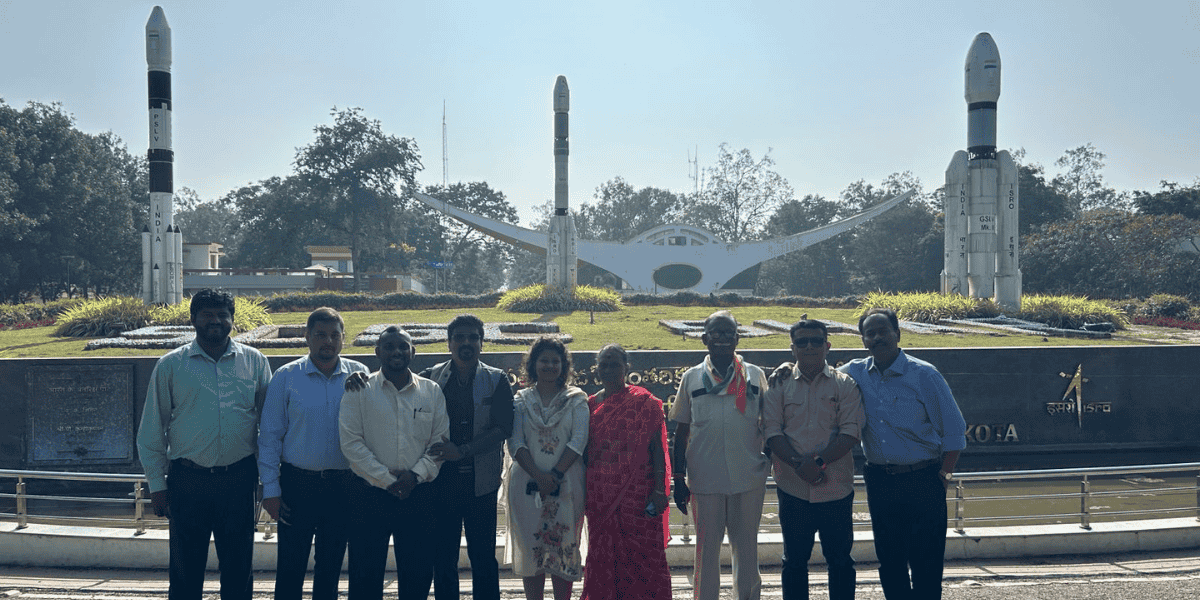
Recently, members of a media delegation from the Andaman and Nicobar Islands were given a rare opportunity to visit and experience this landmark facility through an initiative of the Press Information Bureau. The visit allowed the delegation to closely observe and learn about the functioning, history, and technological achievements of this prideful national spaceport, offering a firsthand glimpse into one of India’s most significant scientific establishments.