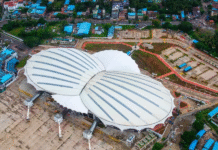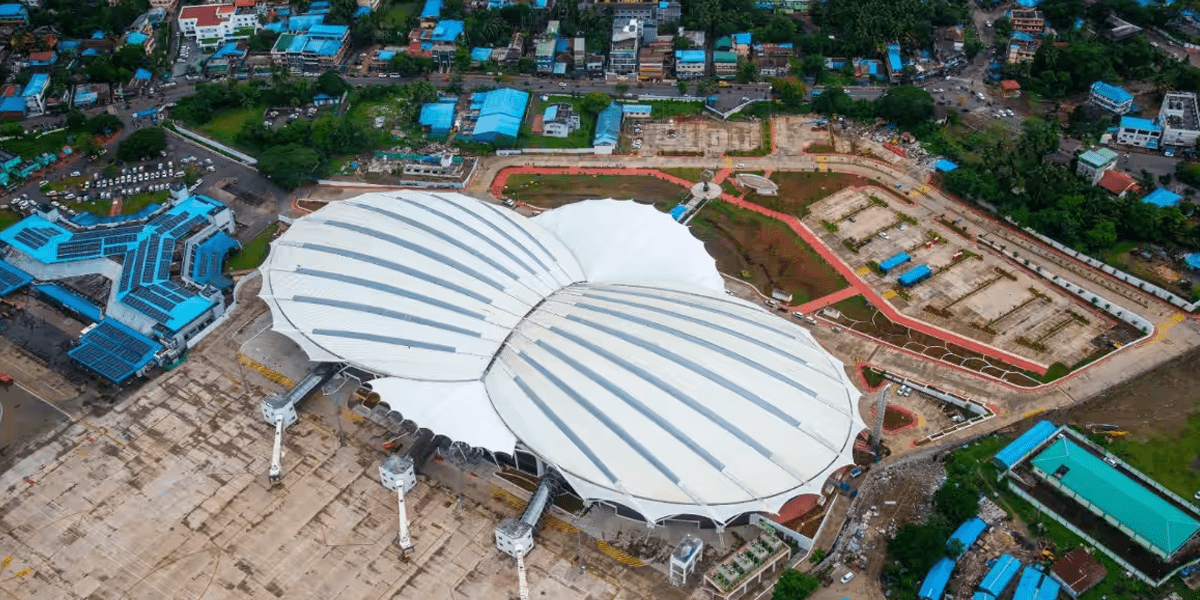
Flight operations at Veer Savarkar International Airport, Sri Vijaya Puram, showed a marked return to normalcy today after days of widespread disruptions that left passengers facing long queues, repeated delays, and abrupt schedule changes triggered by IndiGo’s failure to adequately plan its nationwide operations. Morning arrivals and departures ran largely on time, offering long-awaited relief to island travellers who had endured nearly a week of uncertainty.
Early departures reflected a rare stretch of stability: IndiGo’s 07:25 Chennai flight 6E 581 and its Vishakhapatnam service operated on schedule, followed by Air India and Air India Express flights to Kolkata and Bhubaneswar that also departed on time. IndiGo’s 6E 5165 to Kolkata at 08:45 was additionally listed as punctual, strengthening indications that the airport was gradually regaining rhythm after severe nationwide disruptions.
Arrivals showed similar improvement. IndiGo’s Chennai service 6E 526 landed at 06:44, six minutes early, while Air India’s AI 9944 from Kolkata touched down 20 minutes ahead of schedule. Air India Express flights also arrived as planned, adding to growing confidence that normal operations were finally taking shape at Sri Vijaya Puram.

The easing of delays coincided with significant developments in New Delhi, where the massive travel chaos triggered by IndiGo’s cancellations and delays has come under the scrutiny of Parliament. A Parliamentary Standing Committee on Transport, Tourism and Culture is likely to summon top executives of private airlines, senior officials of the Directorate General of Civil Aviation (DGCA), and representatives from the Ministry of Civil Aviation. The panel, chaired by JD-U MP Sanjay Jha, aims to seek detailed explanations on what led to the nationwide disruptions and what corrective measures are now being taken.
For six consecutive days, IndiGo’s large-scale cancellations left thousands stranded across the country, including MPs travelling for the ongoing Winter Session. Lawmakers have also reportedly received complaints about sudden spikes in airfares due to the cascading operational failures. On Sunday alone, more than 220 IndiGo flights were cancelled at Delhi and Mumbai airports, underscoring the magnitude of the crisis.
The DGCA has issued a show-cause notice to IndiGo CEO Pieter Elbers, holding the airline’s top management accountable for what it described as “massive disruptions” and “significant lapses in planning, oversight and resource management.” The notice, invoking Aircraft Rules and Civil Aviation Requirements concerning pilot fatigue management, directed the CEO to explain within 24 hours why enforcement action should not follow. The regulator observed that the operational collapse caused “severe inconvenience, hardship and distress” to passengers nationwide.
IndiGo has responded stating that its parent company, InterGlobe Aviation, has formed a Crisis Management Group to monitor the situation and ensure timely refunds and operational stabilisation. In a video message, Elbers acknowledged the complexity of the airline’s operations and said full normalcy is expected between December 10 and 15.

Civil Aviation Minister Rammohan Naidu confirmed that a thorough investigation is underway, and any necessary action will be taken with “utmost caution.” The Ministry has also set up a four-member committee and imposed a temporary nationwide cap on domestic airfares—ranging from ₹7,500 to ₹18,000 depending on the route, to contain the sharp price surge triggered by the disruptions.
While the national aviation sector continues to grapple with the fallout of the IndiGo crisis, passengers at Sri Vijaya Puram airport are cautiously hopeful. With flights operating on time through the morning and terminal queues thinning, travellers welcomed what they described as the first “normal day” in nearly a week. Authorities, however, continue to monitor operations closely to ensure that today’s stability extends into the coming days.