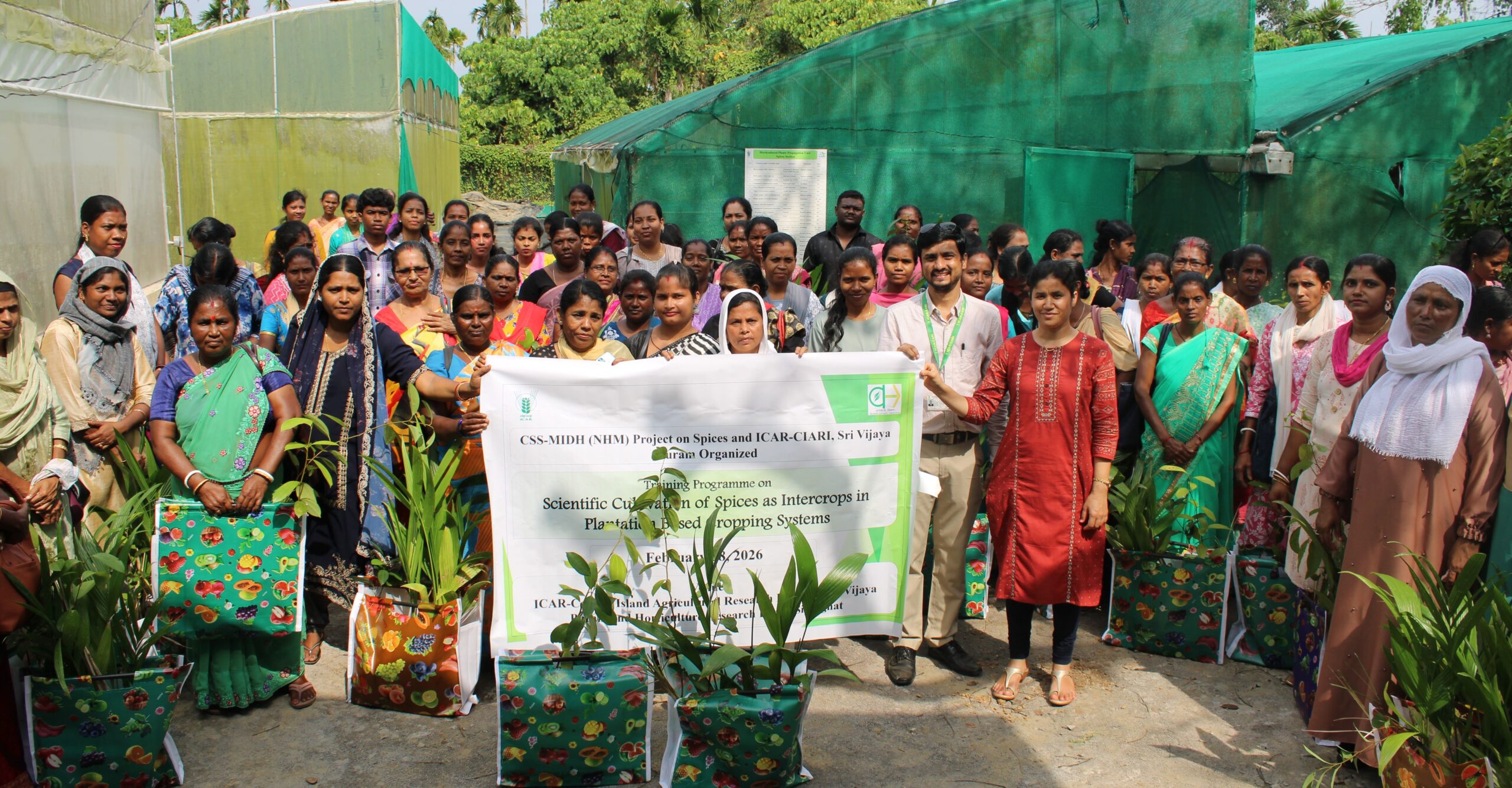
A training programme on scientific cultivation of spices as intercrops in plantation-based cropping systems has opened new livelihood opportunities for women farmers in the Andaman and Nicobar Islands, particularly those engaged in coconut and arecanut cultivation. The programme was organised on February 18 at Sri Vijaya Puram by the ICAR-Central Island Agricultural Research Institute under the CSS-MIDH (NHM) Project on Spices and the All India Coordinated Research Project on Plantation Crops.
Agriculture in the islands is dominated by plantation crops, where wide spacing between coconut and arecanut plants provides scope for high-value intercrops such as spices. However, lack of awareness about scientific cultivation practices, harvesting techniques and post-harvest management has often resulted in low productivity and variable quality. The training programme was designed to address these gaps, with a special focus on women-led self-help groups.
During the inaugural session, the Director of CIARI interacted with participants and encouraged them to seek scientific guidance to overcome challenges in crop, livestock and fisheries sectors. The programme included technical sessions on spice cultivation practices, demonstration of improved harvesting methods and exposure to modern tools developed by the institute for enhancing efficiency and quality.
Participants were introduced to scientific methods of cinnamon cultivation and harvesting, including a live demonstration of the Dweep CinnRub tool developed by CIARI. Educational films on harvesting and post-harvest handling of spices were also screened to familiarise participants with value addition and quality maintenance.
As part of the exposure visit, farm women were taken to the Field Distillation Unit, where essential oil extraction was demonstrated. They also visited the Horticultural Plant Propagation Unit to observe nursery techniques for perennial spices. Protected cultivation of woody pepper was showcased, with discussions on its potential as a novel spice crop for the islands.
The programme also highlighted improved cultivation practices for Malabar tamarind using grafts of improved varieties, along with demonstrations on gravity-fed drip irrigation and weed management through mulching. The importance of soil and water conservation, terracing and shade management for young plants was explained, particularly in the context of changing climatic conditions.
Participants were introduced to foliage-based spices such as tejpat, which are gaining relevance under evolving climate patterns. The programme included information on Dweep Tej-1, the first improved variety of tejpat developed in the country, highlighting its suitability for island conditions.
At the Horticulture Research Farm in Sippighat, intercropping models developed by CIARI were showcased, demonstrating how spices can be integrated under coconut and arecanut plantations to enhance farm income. Participants also visited high-density cinnamon plantations and the World Coconut Germplasm Centre to gain exposure to advanced research and conservation efforts.
To support adoption at the field level, planting material of various spices, including cinnamon, woody pepper, lemongrass and improved arecanut varieties, was distributed among participants. The women were also introduced to value-added products developed from local resources, such as mango ginger culinary paste and Andaman kokum syrup, demonstrating scope for small-scale processing and entrepreneurship.
The training was conducted under the CSS-NHM Project on Spices, funded by the Directorate of Arecanut and Spices Development, Kozhikode. A total of 84 stakeholders, mainly women members of self-help groups from South Andaman, participated in the programme, which was coordinated with support from local development organisations.